Retro Game Guy

It's the 1980's again!


1 Comment

Asteroids…

Asteroids is a classic arcade game released by Atari in 1979.  To this date, it remains Atari’s top selling arcade game with over 70,000 arcade cabinets sold.  In fact, some operators had to install larger coin boxes to ‘catch’ all of the quarters that gamers were putting in these cabinets.

Asteroids is a mono color vector graphics game.  Your ship is in an asteroid belt and you must destroy the asteroids before they destroy you.  If that isn’t enough, your ship is also being attacked by UFO’s.  You can control your ship to spin left or right, thrust forward, or enter hyperspace and reappear in another location.   In 1981, Atari released Asteroids Deluxe which added a killer satellite and replaced the hyperspace feature with shields.  The killer satellite breaks apart when hit and the parts ‘home in’ on your ship.

If you want to play Asteroids on your 2600 or 7800 you are in luck!  In 1981, Atari released Asteroids for the 2600.  The vector graphics were replaced by multi-colored asteroids, but it played great.  There were 66 variations, including options for speed, bonus lives, hyperspace, shields,  flip, and 2 players.  Of special note, Asteroids for the 2600 was the first bank switch cart release by Atari.   A 7800 version was prepared for the system launch in 1984 and is often referred to as 3D Asteroids.  The Asteroids are multi-colored and appear to have a 3D effect.  Again, the game plays great and offers options for difficulty and 2 players.  In Europe, Asteroids was built into the ROM on the system board and would boot if no cart was inserted into the system.

5200 owners were not so lucky.  Asteroids was developed for the 5200 and planned as the launch game for the system.  In fact, it was planned to be a 4 player version, taking advantage of the 4 joystick ports on the original 5200’s.  Sadly Asteroids for the 5200 was not released by Atari and there is a simple explanation as to why…the 5200’s non self centering analog joystick.  Control is almost impossible and you will find your space ship either spinning out of control or rocketing across the universe until it  crashes into an asteroid.  Supposedly, Atari was looking at developing a special controller for Asteroids, but it, like the game, never made it into production.  In addition to the control problems, the game does not take advantage of the capabilities of the 5200.  Graphically, it is not any better than the 2600 version.  If you have a 5200 multi-cart or emulator, you can give the 5200 version of Asteroids a try.  Also, a few carts of Asteroids for the 5200 have been made and you might be able to get your hands on one of these.  Otherwise, don’t sweat it and just play one of the great 2600 or 7800 versions.

For 7800 fans, there is also the possibility to play Asteroids Deluxe.  In 2007, Bob ‘PacManPlus’ DeCrescenzo heavily modified the original 7800 Asteroids code to produce Asteroids Deluxe for the 7800.  Bob’s version simulates the mono-color vector graphics of the arcade version and takes advantage of the second 7800 controller fire button to activate the shields, but also works well with a standard, single button Atari joystick.  Bob’s version also features the ‘killer satellites’ that break apart and ‘home in’ on your ship…just like the arcade!  An added bonus is also included…hold down the pause button while powering up your 7800 (with the Asteroids Deluxe cart inserted) and the system will boot to a simulated vector edition of standard Asteroids!  Bob’s Asteroids Deluxe is about as close to the arcade experience as you are going to get on a home system!!!  Click to learn more about Asteroids Deluxe for the 7800.
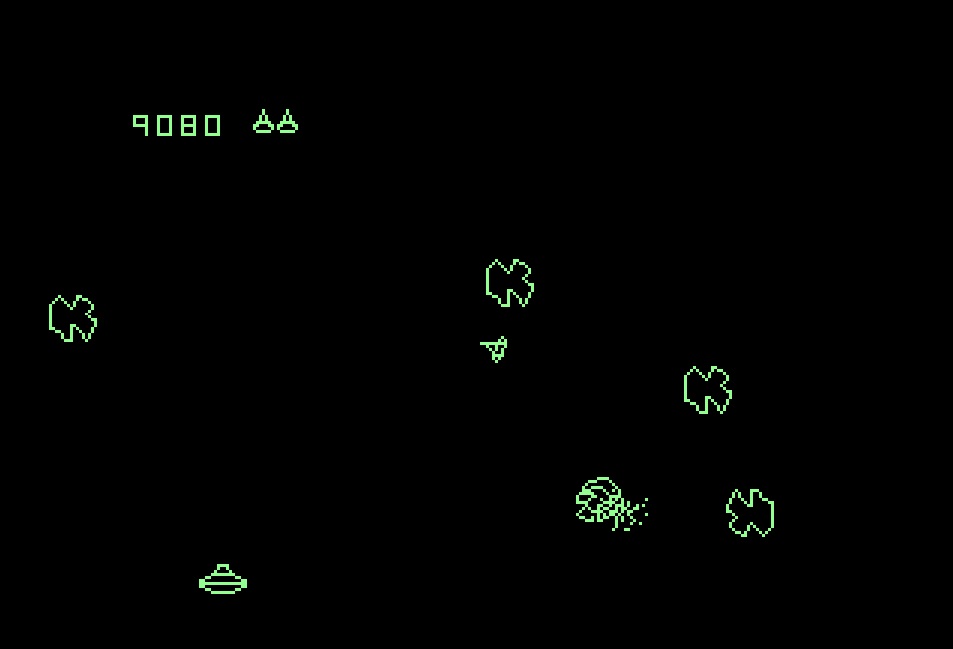
7800 Asteroids Deluxe

7800 Asteroids Deluxe

Until recently, 2600 fans had to be happy with the original 1981 version.  There was one hack that made the asteroids look more like the vector graphics of the arcade, but no additional features were added.  Enter Darrell Spice and his new game ‘Space Rocks’.  Space Rocks will take advantage of the capabilities of the Melody board developed as part of the Harmony Cart project.  The game will be a 32K game and take advantage of the ARM processor on the Melody board.  Space Rocks is best described as Asteroids Deluxe for the 2600.  It features great sound effects, courtesy of PacManPlus, and options for  ‘vector’ or solid asteroids, shields, hyperspace, difficulties, and Magna Mines (Killer Satellites).  The options are selectable on a main menu page which is a big improvement over having to remember which version is which.  Space Rocks is ‘coming soon’ to the AtariAge store, but I have had the opportunity to play the latest release candidate and this game rocks!  Of particular note is how your ship ‘warps in’ and the thrust can be seen when you maneuver.   It is hard to believe that it is a 2600 game and, if you are a 2600 fan, you need to be one of the first to order this game when it becomes available!!!  Click to learn more about Space Rocks.

Wild for Asteroids!


1 Comment

Game Over?

Last weekend, I was on a business trip to Europe and had Saturday free in Amsterdam.  I had heard about a retro game shop near Central Station and decided to go check it out.  I jumped on a tram at a stop near my hotel and took it downtown.  Sure enough, on a small street near Central Station, there is a retro game shop called ‘Game Over?’.

This shop has all kinds of cool stuff, including tons of games and consoles.  They had systems from Atari, Nintendo, Sega, and Sony as well as a great selection of used games.  I could go on and on, but I found this great video on YouTube that is better than any description that I could write.

If you happen to be in Amsterdam and want to check out a cool retro game shop, be sure to stop by Game Over?

Game Over?


Leave a comment

Multi-carts…

When I started this adventure a few months ago, I had never heard of a multi-cart.  A multi-cart is circuit board, usually mounted inside a standard cartridge shell, that allows you to load multiple games on either flash memory or some type of memory card.  As it turns out, some very creative and talented individuals have developed multi-carts for almost all retro game systems.  For example, multi-carts have been made for the Atari 2600, 5200, 7800, Colecovison, Vetrex, Intellivison, and others.

Multi-carts have become a critical part of the retro gaming community as they allow developers to quickly load and test their games on real hardware.  They also make it possible for others to test game release candidates and report bugs back to the developers.  They are also great for the gamer as a whole library full of games can be put on a single cart, saving wear and tear on cartridge ports.

The Atari 7800 multi-cart was made by Chad Schell and was called the Cuttle Cart 2.  It is estimated that Chad built and sold about 200 of these and they are highly sought after.  The Cuttle Cart used a MMC to load and store the games.  The Cuttle Cart 2 is no longer in production, but you can learn more about it at Chad’s website.

Atari 5200 and Colecovision fans are in better luck as Steve Tucker makes and sells multi-carts for these systems.  Recently, I purchased Steve’s ‘Atarimax Ultimate SD Multi-Cart’ for my 5200 SuperSystem.  This Multi-Cart is an amazing product that allows you to put all of your 5200 games on a single cart.  Steve has also ported over more than thirty 8-bit games including classics like Atlantis, Demon Attack, and Donkey Kong.  Additionally there are a number of hacks, homebrews, and prototypes available for the 5200.  To see all of Steve’s cool products, check out his Atarimax website.

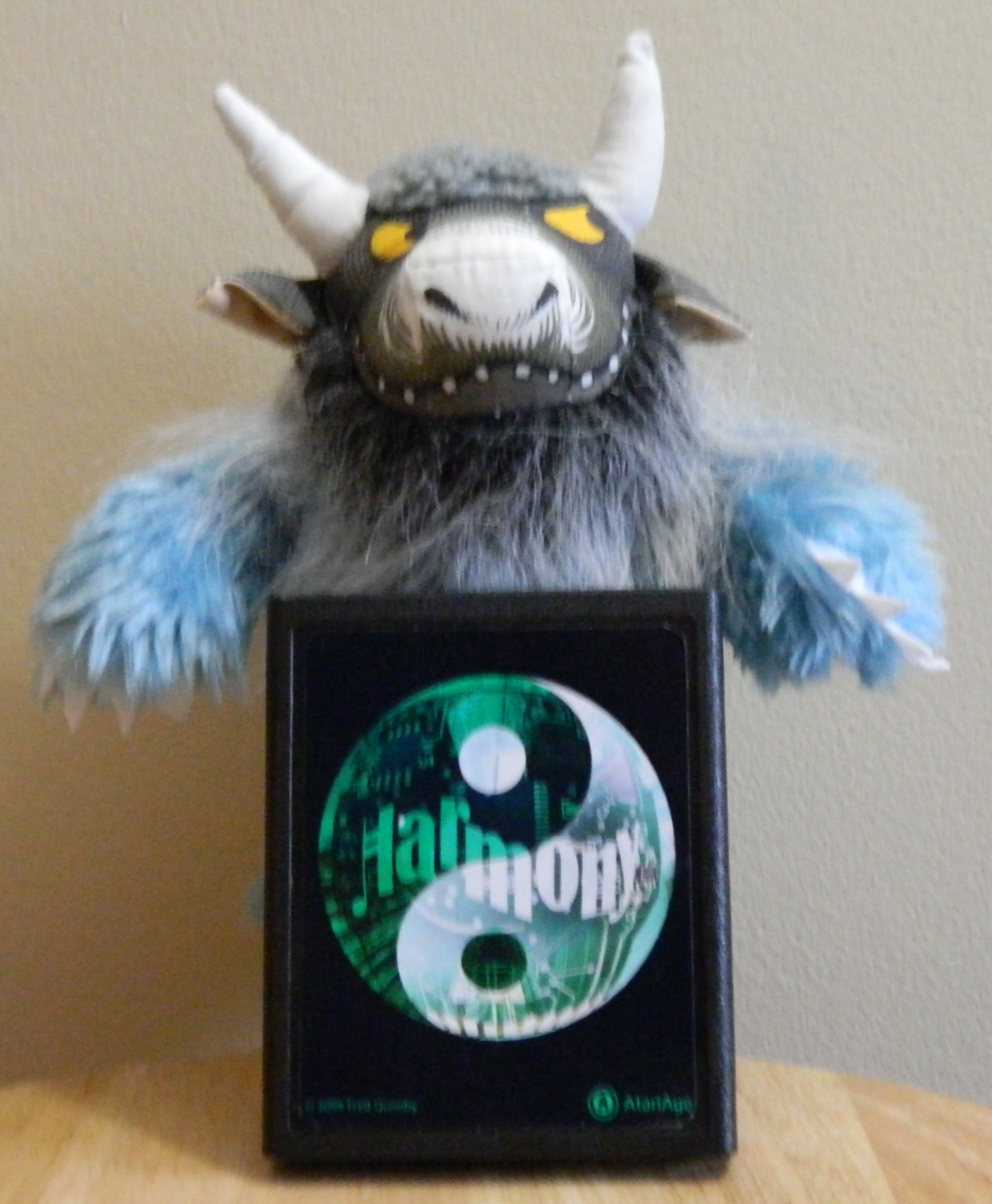
2600 fans are also in luck as a great multi-cart is readily available.  Developed by a team of great guys from the AtariAge forum, the Harmony cart is available for both SD and micro-SD memory cards.  The Harmony cart also works with the 7800 and allows you to play almost all of your 2600 games on either your 2600 or 7800.  Since purchasing my Harmony cart, I have been able to test and provide feedback on the development of a couple of new 2600 games as well as play a number of homebrews and hacks.

The same team that developed the Harmony cart are also working on the H2.  The H2 cart will be compatible with 7800 games.  This will allow those of us who do not have Cuttle Carts to help with development of new games for the 7800.  The development of the H2 has been slow, but it should, hopefully, become available in 2013.

Hooray for Harmony!


Leave a comment

Paddle Games…

I have always enjoyed paddle games for Atari.  Maybe because they were simple to play, or maybe because they provided some variety and that there weren’t that many of them.  Of course, it was a paddle game that started the home video game market…Pong!  Pong was developed by Atari engineer Allan Alcorn in 1972 and a home version was released by Atari/Sears in 1975.  For the 2600 (VCS), one of the earliest game cartridges was Video Olympics (1977) with fifty different variations of Pong.

Other great paddle games for the 2600 include: Breakout, Super Breakout, Circus Atari, and Warlords.  Warlords is a simple, but fantastic game and is an awesome party game as up to four people could play at the same time.  Darrell Spice Jr.  has updated the Warlords concept with his homebrew game ‘Medieval Mayhem‘.  This game has improved graphics and sound, but has the same great Warlords game play!

Another outstanding paddle game, developed by Activision, is Kaboom!  If you take a look at my ‘About’ page, you will see me with some friends playing Kaboom! circa 1982.  I can remember playing this game over and over!

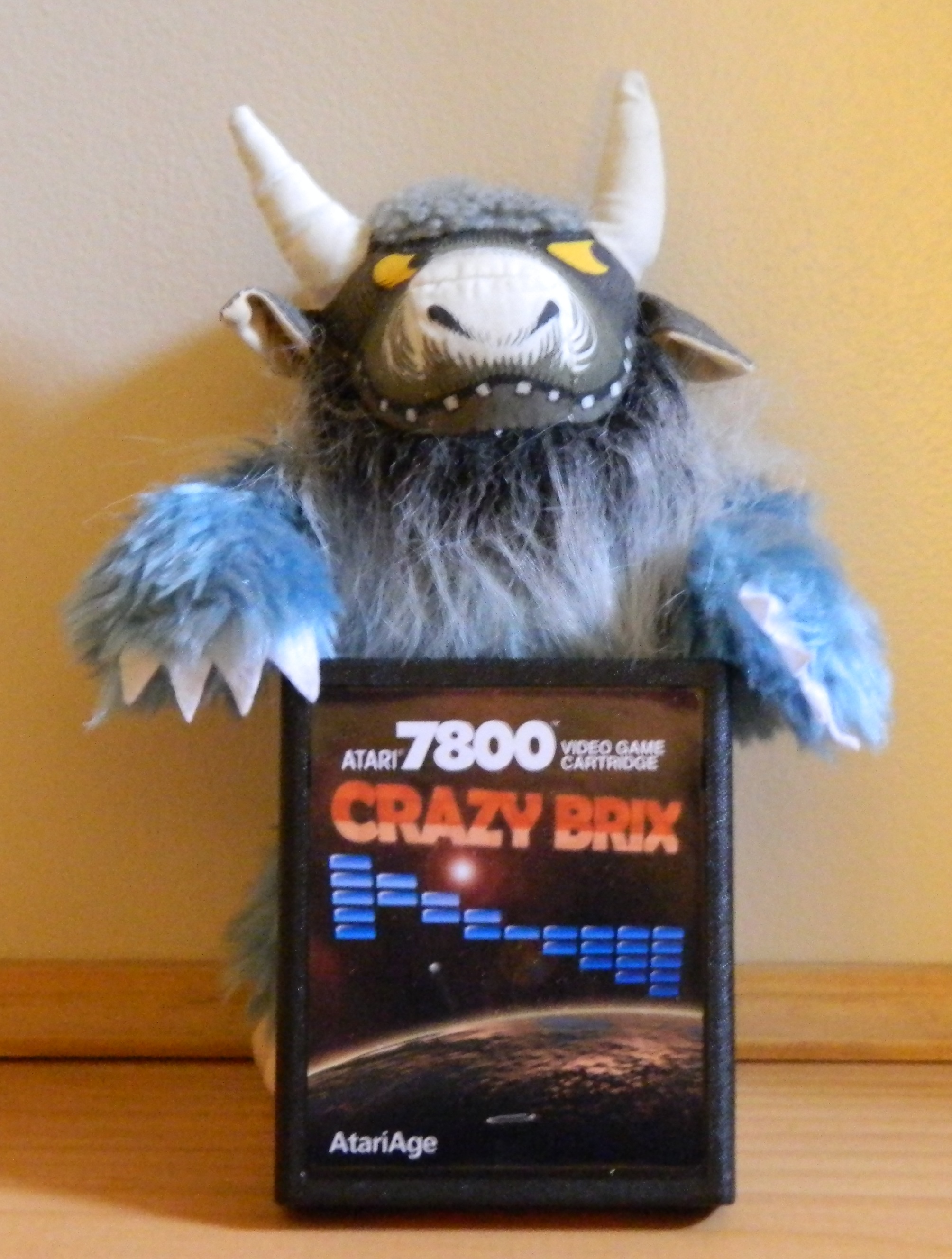
If have a 7800 and like paddle games, your only option was to play the 2600 classics.  Recently, however, a new paddle game ‘Crazy Brix‘ has been developed by Bob DeCrescenzo.  Crazy Brix brings the Breakout concept to the 7800 with some cool twists.  A couple of new things are having two balls to ‘juggle’ and having the ‘Brix’ patterns change.  In fact, if you get through the first few levels, you will really enjoy some of the patterns at the advanced levels!

One of the problems with paddle games is not the games, but the paddles themselves.  The original Atari CX30 paddle controllers have a tendency to become ‘jittery’ after a short time.  Best Electronics has been able to source replacement potentiometers for the CX30’s and I recently purchased a pair of upgraded paddles from them.  I have to say that these upgraded CX30’s are awesome…very smooth and jitter free!

Another potential option are the new paddle controllers from AtGames.  I am not sure what the quality of these will be, but they should be widely available soon.

In summary, if you want a change of pace from joystick games, pick up some paddle games from your local retro game shop or the new ones that I mention in this blog!

Crazy for Crazy Brix!


Leave a comment

Having a Flashback?

An Atari Flashback that is…

Atari (and AtGames) have released several ‘Flashback’ systems starting with the original in 2004.  The original Flashback looked like a micro 7800 and included a combination of twenty built in 7800 and 2600 games.  It was designed and brought to market on a short timetable and was built around an ‘NES on a chip’. Thus, all of the games ran in emulation mode.  Some hard core Atari fans did not like the Flashback, but it sold nearly a million units and convinced Atari to release the Flashback 2 in 2005.

The Flashback 2 (and 2+), like the original Flashback, was designed by Curt Vendel of Legacy Engineering.  This time around, the Flashback looked like a micro 2600 included 40 built in games.  Curt actually designed a ‘2600 on a chip’ so that the Flashback 2 was capable of running almost all 2600 games.  One of the cool things about the Flashback 2 is that Curt included solder points on the motherboard to add a cartridge slot.  Many Atari fans have done this mod to their Flashback 2 so that they can play most of their cartridge based games, as well as the 40 built in games.

In 2011 Atari allowed AtGames to build and market the Flashback 3.  The Flashback 3 includes 60 built in games and is built around an ARM processor, so all games run in emulation.  Like the Flashback 2, it uses Joysticks designed to look like the original Atari CX40.  You can also use your original Atari joysticks and paddles with this unit.

For 2012, AtGames is back with the Atari Flashback 4, due to be released in a few days.  This time around it will include 75 built in games including a new version of Space Invaders.  Some of the other classic games included in the Flashback 4 are:  Asteroids, Battlezone, Centipede, Jungle Hunt, Missile Command, and Super Breakout.  AtGames will also be selling a ‘Deluxe Edition’ that includes a set of paddles.  You will still be able to use your existing joysticks with the Flashback 4, but, for the first time, they are including wireless joysticks!

Ok, if you have a 2600 or 7800 why would you buy an Atari Flashback?  There are actually a few good reasons.  The first is that these typically sell for $40 or less and are a lot of fun.  Second, they have an AV output and work much better with today’s TV’s.  Third, the joysticks are pretty good.  They have a ‘looser’ feel than the original CX40’s, but work great.  I was able to pick up a new Flashback 3 at a local store for under $30.  At that price, it was worth it just to get the two joysticks!

If you are looking for some fun at a reasonable price, consider getting an Atari Flashback.  For more information on the Flashback 4, check out the description at AtGames!


Leave a comment

Moon Cresta…

Moon Cresta is a 1980 Arcade game developed by Nichibutsu. It is a single player (or two player, alternating) space shooter and was unique at the time for it’s multi-level concept. Instead of the usual format, in Moon Cresta you get a three part ship. For a 1980 arcade game, the variety and movements of the aliens are amazing. To start the game, you get the first part of your ship. If the aliens destroy part of your ship, then you get the next part. If you successfully destroy four alien waves, you must dock with the remaining portions of your ship. The quicker that you are able to dock , the more bonus points you will receive. When docked, your ship is larger and easier for the aliens to hit. Also, when firing, the cannons will alternate firing from different parts of your ship. Since the cannons are spaced differently, this has an impact on your aim. When all three parts of your ship have been destroyed, the game is over. At 60,000 points, you earn a bonus play. Click on this link to learn more about the arcade version of Moon Cresta.

Moon Cresta has become one of my favorite games for the 7800. The 7800 version was written by Bob DeCrescenzo in 2011 and Bob provided a few carts to Atari retro gamers last fall. Just recently, Moon Cresta has become available for order at the AtariAge store. Bob’s 7800 version is true to the arcade and the graphics look great. Bob spent quite a bit of time getting the alien movements to work correctly and the result is fantastic. Moon Cresta is a hard game and it took me a long time to finally get to 10,000 points. I was hoping that some type of bonus would happen at 10,000 points, but the bonus occurs at 30,000 points in the 7800 version. So far, I have only managed to get to 30,000 points 3 or 4 times. I can’t image ever being able to play Bob’s Moon Cresta on the most difficult setting. Once again Marc (Freelancer Games) has done an outstanding job with the label and box graphics. Click here to learn more about the development of the 7800 version of Moon Cresta. To buy a copy of Moon Cresta for your 7800, visit the AtariAge store.

Wild for
Moon Cresta!


Leave a comment

Controllers…

The 7800 is different from the 2600 in that it was supplied with joysticks with two (independent) ‘fire’ buttons.  Many 7800 games are programmed to take advantage of this second ‘fire’ button.  In the US, the 7800 was supplied with the CX24 joystick. The CX24 is not the most popular joystick, as the length of the shaft and the location of the buttons have a tendency to cause hand cramps after just a few minutes of game play.  A great guy who goes by Yurkie on the AtariAge forum will modify your CX24 controllers by shortening the shaft and adding a ball knob.  I had Yurkie do this to a set of CX24 joysticks for me and this mod makes a huge difference.  If you have a set of CX24’s and find them difficult to use, consider having Yurkie mod them for you.

The 7800 was released in Europe in 1989 and Atari supplied the CX78 gamepad with all European 7800’s.  The CX78 is similar to the NES controllers and was well received.  The CX78 is a great option if you are unhappy with the CX24’s.  Although some folks would have you believe that the CX78’s are hard to find in the US, they can be purchased new from Best Electronics at a very reasonable price.

Many 7800 games (like Ms. Pac-man, Centipede, Space Invaders, etc.) only require a single fire button.  For these games (and almost all 2600 games), a normal Atari CX40 joystick will work perfectly on your 7800.

What I have found is that I prefer different joysticks for different games.  For single fire button games, I will use my CX40.  For two fire button games that require a lot of use of the second button, I prefer my modded CX24.  For other two button games, I will use my CX78 joypad.

Finally, there are a few 7800 games (I will cover these in a future post)  that either require a light gun or can be used with one.  Atari never made a light gun specifically for the 7800, but they are not hard to find.  Atari supplied one with each XE Game System and Best sells their own Atari compatible light gun.  Remember, with a light gun, you need an old fashioned TV with a glass screen!

Wild for the CX78 Joypad!


Leave a comment

In Search of Carts…

As I mentioned in a previous blog, in order to produce new homebrew games, existing carts need to be sacrificed. In some cases, new circuit boards for carts are available and only the shell needs to be recycled. In other cases, both the shell and board are reused. The most desired cart to reuse is the 7800 cart with out a dust cover. Later 2600 (mostly red label) carts also used this same shell. They are popular for homebrews as these shells can hold either 7800 or 2600 cart circuit boards.

It is a lot of work to produce homebrew games and one of the major challenges is tracking down donor carts. There are a few of us that help out the community, by buying up old carts and providing them to game developers and the places like AtariAge. Ebay is one place that donor carts can be bought, but the prices tend to be high, except in large lots. Other options include garage sales, swap meets, and retro game stores.

Yesterday, I visited a retro game store on Route 4 just east of Concord, New Hampshire called ‘Final Stage Video Games’. This is a small shop with all kinds of retro gaming equipment and games run by a great guy name John. Yesterday I saw all kinds of Atari, Nintendo, Sega, and Sony equipment and games. John even had a Commodore 64 in the original box! When I told John why I was there, he helped me dig through his Atari cart collection and find all of the later model 2600 carts a well as a few 7800 carts. With John’s help, I walked out of the shop with a bag full of potential donor carts

One day cart shells and 7800 boards may be manufactured again, but for now they have to be recycled. A few must die so that others may live!

Final Stage Video Games


Leave a comment

Space Invaders…

The Space Invaders arcade game was developed by Tomohiro Nishikado and released by Taito in 1978. It was a smash hit and Taito sold more than 300,000 Space Invaders arcade games in the first two years. It was so popular in Japan, that it actually created a shortage of 100 yen coins. By today’s standards, it is a pretty simple game; 55 aliens move back and forth and come ever closer to your laser cannon. The aliens also attack with laser bombs and move faster as you destroy them. The original games were a single white color and colored cellophane was used on the display to make it appear that the game was multicolored.

Back at Atari, Rick Maurer was developing a VCS (2600) version of Space Invaders. He got a prototype version of it working, but no one seemed interested. He, thus, moved on to the development of another game. In 1980, Atari was able to license Space Invaders and they had Rick complete his work on the 2600 version. It was a smash hit; the first Atari game to sell over a million copies and is credited with quadrupling sales of the 2600! The 2600 version of Space Invaders was pretty darn good; there were only 36 aliens, but it had variations that the arcade game did not. Rick added 112 variations such as 2 player modes, moving shields, zigzagging bombs, and invisible invaders. If you had a 2600, I am sure that you also had a copy of Space Invaders!

In 1982, Atari released the 5200 ‘SuperSystem’ and Space Invaders was one of the launch titles for this system.  The 5200 version of Space Invaders has a total of 48 aliens that enter from the left and march across the screen, before starting their back and forth movement.  The aliens are multi-colored and mutate their shapes in advanced rounds of the game.  Atari included a total of 12 variations as well as 1 or 2 player options.  The variations include 3 or 5 lives, slow or fast bombs, alternating slow and fast bombs, and bombs that home in on your laser cannon.  The control in this game is pretty good with a standard 5200 joystick, but the 5200 track ball gives finer control of your movements.  Atari included a nice touch by having the sound of the aliens increase as they get closer to the bottom of the screen.  The 5200 version of Space Invaders is not really a port of the arcade version, but, rather, a new concept for the game.  The concept isn’t bad, but it could have been better executed.  The graphics are not really much better than on the 2600 version and this game does not really show what the 5200 is capable of.  Space Invaders for the 5200 is still fun to play, but it could have been a whole lot better.

In 1984, Atari released the 7800 ‘ProSystem’  and officially cancelled the 5200.  Atari developed 7800 specific ports of many arcade classics, but not Space Invaders. Fortunately, Bob DeCrescenzo has done an excellent port of Space Invaders for the 7800. Bob’s game is true to the arcade with all 55 aliens and adds similar options to Rick’s 2600 version such as such as 2 player modes, moving shields, zigzagging bombs, and invisible invaders. Bob also added color options to reflect the different cellophane overlays that were used on the arcade systems. Bob’s version is challenging, addictive, and a ‘must have’ for anyone who has a 7800! Space Invaders for the 7800 is available from AtariAge.

7800 Space Invaders

7800 Space Invaders

If you are lucky enough to have played Space Invaders on all three Atari systems, then I am sure that you will agree with me the Bob’s 7800 version is the clear winner.  If you don’t have a copy Space Invaders for the 7800, rush over to AtariAge and order yourself a copy of this great game!

Wild for Space Invaders!


Leave a comment

Unreleased Games?

The 7800 was originally planned to be released in 1984, but the great video game crash and Atari’s sale to Jack Tramiel, held up the release until 1986.  Some games that were in development were shelved at that time and others when Atari stopped making the 7800 in early 1992.  As it turns out, there were some great games, that were nearly complete, that were never released.

Over the years, the code for some of these games has been located and a few of these games have been made playable and released by 7800 enthusiasts.  Some of these games were able to be complied and released on carts to the 7800 community.  Three outstanding games that have been made available are: Klax, Plutos, and Sirius.

Klax was a 1989 Atari coin op game that was released for the 2600, the NES, and the Sega Genesis, but not for the 7800.  Klax is a computer puzzle game along the lines of Tetris. Klax for the 7800 was, apparently, completed but never released.  Almost a decade ago, Klax was rescued and can now be played on the 7800. I don’t have a copy of Klax for the 7800 yet, but it is on my wish list and it should be on yours as well.

Plutos and Sirus were games in development by the British company Tynesoft.  The source code for these games was found in 2008 by Curt Vendel and three talented programmers (Bob DeCrescenzo, Mitchell Orman, and Eckhard Stolberg) were able to compile stable versions.  A couple of other enthusiasts have made carts available to the 7800 community. Theses games are very similar; Plutos is a vertical scrolling space ‘shoot um up’ and Sirius is a horizontal scroller. I was recently able to get my hands on carts of these games and they are amazing. The graphics in these games set the bar for what the 7800 is capable of and they are fun to play as well!  Had they been released back in 1990, they probably would have been big sellers.

Other games that have been found in various states of completion are: Gato, Pit Fighter, Missing in Action, Rampart, and Rescue on Fractalus.  Games that were announced for the 7800, but are still missing are: Electrocop, Millipede, Sky Fox, and Steel Talons. One day, the source code for one or more of these missing games may be located and released to the 7800 community.

For more info on the games in this blog check out Atari Protos.