Retro Game Guy

It's the 1980's again!


1 Comment

Centipede…

Centipede is a 1980 video game developed by Atari.  It is notable in that it was one of the few video games that was co-developed by a woman (Dona Bailey) and, also had a large female following.  Centipede was a monster hit for Atari and it could be found in nearly every arcade in the early 80’s.  Centipede is based on the standard Atari hardware of the era with a single 6502 CPU, a single Pokey chip,  and a 16 color CRT.

The concept of the game is pretty straight forward.  The centipede starts at the top of the screen and moves down a level every time it encounters a mushroom.  You must use your wand (blaster) to shoot the centipede before it gets to you.   If you hit the centipede in a center section, it will split in two.  You must also defend yourself from spiders that enter from the sides and fleas that fall from the top.  Scorpions periodically run across the screen and ‘poison’ any mushrooms that they contact.  If the centipede contacts a poison mushroom, it will ‘fall’ to the bottom of the screen.
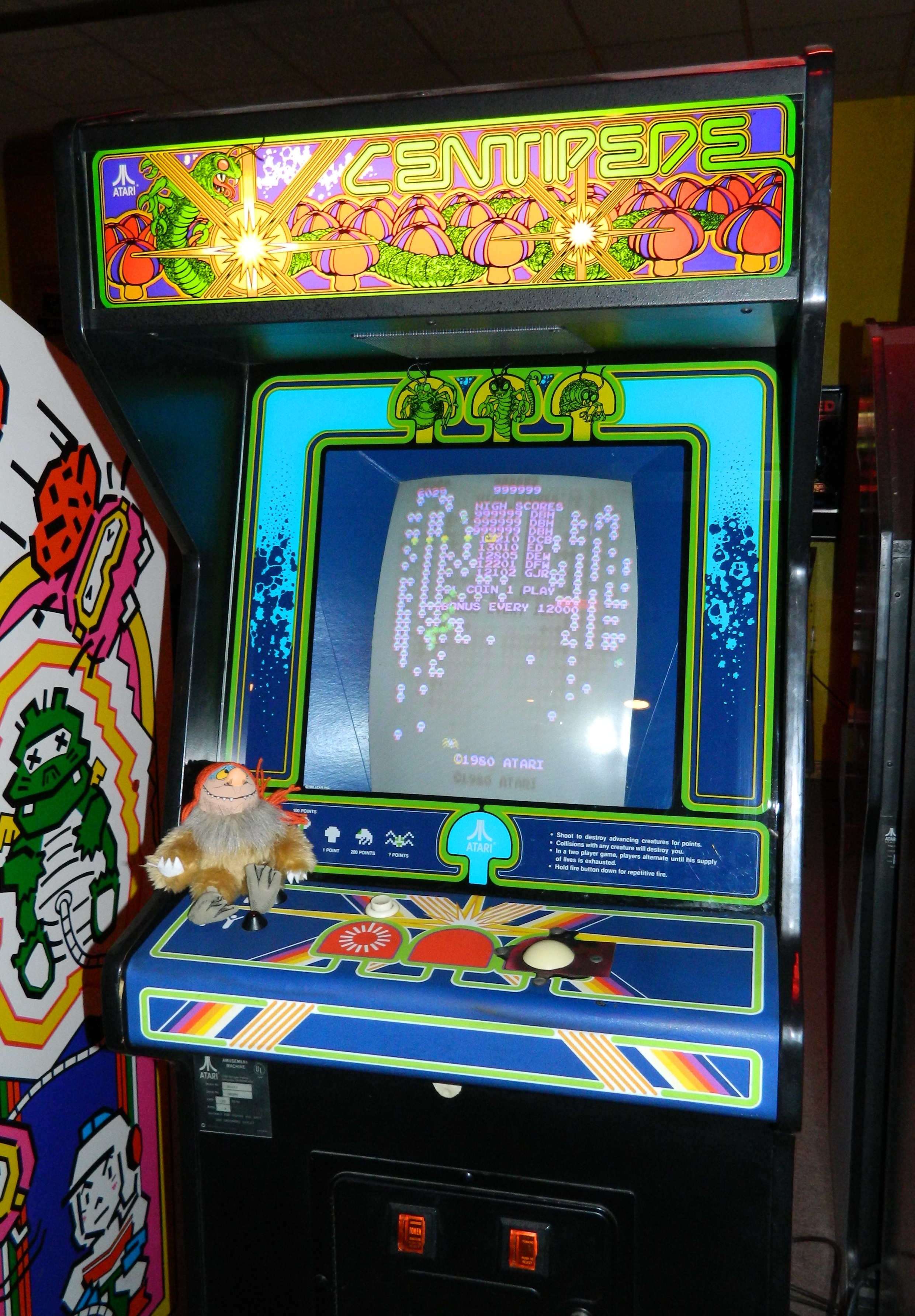
Centipede at Funspot

Centipede at Funspot

Centipede was ported to a number of home consoles and computers including the Apple II, the Commodore 64, and the Atari 800 and the Atari 2600, 5200, and 7800 consoles.  In fact, it is one of the few games to be ported to all 4 of Atari’s 8-bit game systems.

In 1982, Atari released Centipede for the VCS/2600 and, when you power up your 2600 with a Centipede cartridge installed, you will be amazed with the start screen…you will think that you are about to see an amazing graphical port for the 2600.  Unfortunately, the start screen is as far as the amazing graphics go.  The game graphics are disappointing as the mushrooms have become simple square blocks.   As far as the game play goes, however, the 2600 version has it all…mushrooms, spiders, fleas, and scorpions.  It plays as close to the arcade version as any 2600 port.  In fact, Centipede is one of the top games for the 2600!

When the 5200 SuperSystem was introduced in 1982, Centipede was one of the early releases.  Given that a Centipede arcade unit has the same basic CPU and sound chips as a 5200, it should be no surprise that the 5200 version is a classic port.  Like the 2600 version, all of the arcade elements are present, but this time the graphics and sound are spot on.  Control with a standard 5200 joystick is solid, but the 5200 version supports the use of the Trak-ball unit.  Centipede is one of the top games available for the 5200.

In 1987, Atari released Centipede for the 7800 ProSystem.  Even though the 7800 lacks the sound capability of the 4 channel Pokey chip, Centipede is well executed with a nice start screen, great graphics, and more than adequate sound.   The only thing negative to say about the 7800 graphics is the box that is drawn around the screen.   The 7800 version makes up for any shortcomings with neat two player modes.  Two players can alternate turns, play against each other (at the same time), or play together as a team.

It is hard to say which version of Centipede is the best port.  The two player modes in the 7800 version make it a blast to play with a friend, but I give a slight edge to the 5200 version for its accuracy to the arcade version.  No matter which Atari home console you have, a copy of Centipede belongs in your game collection!
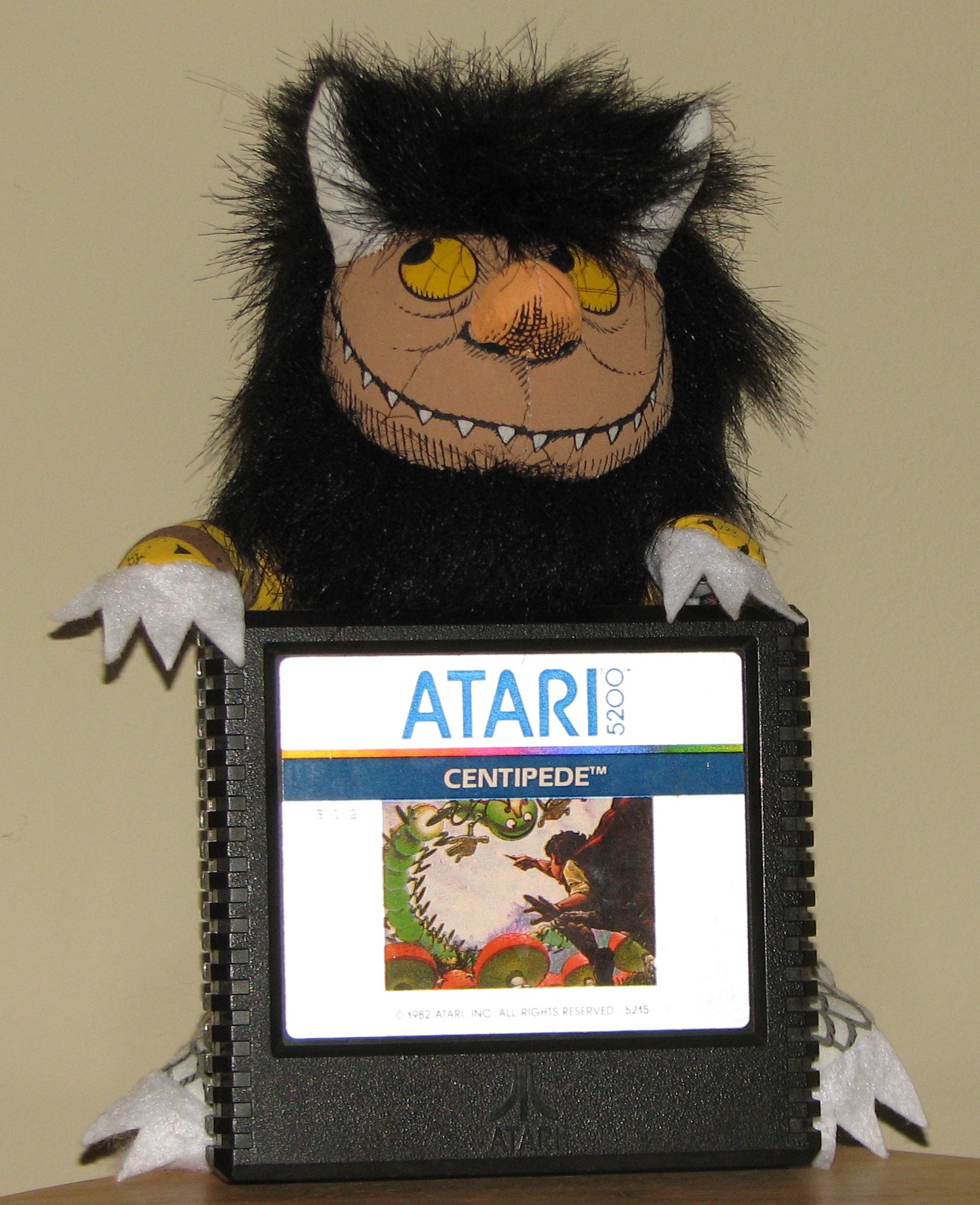
Wild for Centipede!

Wild for Centipede!


1 Comment

Atari 5200 Pac-Man games…

There were only two officially released Pac-Man games for the 5200 (Pac-man and Ms. Pac-Man), but thanks to the efforts of the Atari community, there is now  a complete library of Pac-Man games for the Atari 5200.

Pac-Man…

Pac-Man was one of the launch titles for the 5200 and it is pretty darn good.  In fact, compared to the rather pathetic 2600 version, this game is almost arcade perfect.  The maze has been modified to fit a TV screen, but, otherwise it is all here.  Great colors, arcade like graphics, no flicker, and even intermissions! The only complaint that one could have would be with the 5200 controllers making it difficult to navigate the maze.  I tested the game with a newly re-built controller and found that it only took a few minutes to get used to the feel of the analog joystick. Pac-Man became the ‘pack in’ game for the 5200 in 1983, so it is easy (and cheap) to find a copy.  Pac-Man belongs in every 5200 game collection.

If you want to play a good game, made even better, Bob ‘Pac-Man Plus’ DeCrescenzo ‘hacked’ the 5200 version of Pac-Man to correct some short comings.  Specifically, Bob fixed the ‘flashing’ of the ghosts, the speed of the game to match the arcade version, and the board where the energizers last forever.  Bob’s version is  not available on cart, but you can play it on an emulator or multi-cart.  Read here for more about Bob’s fixes for Pac-Man.

Pac-Man Plus…

Bob ‘Pac-Man Plus’ DeCrescenzo ‘hacked’ the 5200 version of Pac-Man to create Pac-Man Plus.  Bob changed the mazes to be green, changed the ghosts to have leafs on their heads, and changed the fruits to match the bonus items in the arcade version.  He also added some of the other Pac-Man Plus features such as sometimes having the maze turn invisible and having one of the ghosts sometimes not turn blue.  Be warned that these changes make this game more challenging to play, so you will not get bored quickly.  I don’t think that this variation has been made available on a cart, so you will need a multi-cart or emulator to play this version of Pac-Man Plus.  Read more about Bob’s development of this game here.

Hangly-Man…

Hangly-Man was a 1981 clone of Pac-Man by Nittoh.  It is really just a ‘hacked’ version of Pac-Man in a regular Pac-Man cabinet.  The game play is similar, but the mazes are slightly different.  Also, on the third maze and every odd maze after the third maze, the maze is not a maze at all.  There are a few other differences from Pac-Man that is well documented here.  Once again, Bob has come to the rescue and created a version of Hangly-Man  for the 5200.  In the development of his games, Bob always pays attention to detail and this ‘hack’ is no exception.  All of the major features of Hangly-Man are present in Bob’s version.   I don’t think that this variation has been made available on a cart, so you will need a multi-cart or emulator to play this version of Hangly-Mans.  Read more about Bob’s development of this game here.

Pac-Man Arcade…

Perry Thuente started with the 8-bit version of Pac-Man and developed Pac-Man Arcade.  He then ported his 8-bit version to the 5200.  If you are a fan of Pac-Man and have a 5200, then you will want to get a copy of this game.  Perry will either make a cart or provide a copy of the game for your multi-cart for a very reasonable price.  Differences from the ‘standard’ 5200 version includes great title and intro screens, a better looking maze, better looking ghosts (with white eyes), and improved sounds.  You can read more about Perry’s work here.

Ms. Pac-Man…

Ms. Pac-Man was an official release for the 5200 and is an excellent arcade conversion.  Developed by General Computer Corporation and released in 1983, Ms. Pac-Man demonstrates the strength of the 5200 as a great home console for arcade ports.   This game has great graphics, intermissions, four different mazes, bouncing fruits, and four mostly flicker free pesky ghosts with white eyes!  The AI for the ghosts was improved in Ms. Pac-Man, so they are definitely pesky and more difficult to avoid.  Fortunately, you get five lives as you are going to really need them!  Ms. Pac-Man is not quite as easy to find as Pac-Man, but should not be considered a rare title.  A copy Ms. Pac-Man should have a home in every 5200 collection!

Super Pac-Man…

Super Pac-Man was developed and completed for the 5200, but never officially released.  This is really a shame, as this game is almost arcade perfect.  The colors are bright, all of the arcade features are included, and this game provides some variety from the ‘standard’ Pac-Man format.  AtariAge produced a few carts of Super Pac-Man, so you might be able to find a copy or ask them to make you one.  Otherwise, you will need a multi-cart or emulator to play this game.  You can read more about the 5200 version of Super Pac-Man here.

Jr. Pac-Man…

Jr. Pac-Man is another great game that was developed for the 5200, but not officially released.  This version is very close to the arcade and, like the arcade, the screen scrolls horizontally, there are six power pills, and the fruits have been changed.  As the fruit bounces, it changes the dots into larger, more valuable dots, but can also destroy the power pills.  Since this can be happening off-screen, there is some additional strategy to Jr. Pac-Man than other versions.  The only negative thing to say about the 5200 version is that there is some flicker with the ghosts, but nothing that detracts from the game play.  AtariAge produced a few carts of Jr. Pac-Man, so you might be able to find a copy or ask them to make you one.  Otherwise, you will need a multi-cart or emulator to play this game.  It is really too bad that Atari never released this game as it would have been a big hit with 5200 owners.  You can read more about the 5200 version of Jr, Pac-Man here.

Thanks to the Atari community, at least seven great versions of Pac-Man are available to be played on the 5200.  It is always hard to pick a favorite, but, on the 5200, I really enjoy the extra strategy and difficulty of Pac-Man Plus.

Wild for Pac-Man 5200!

Wild for Pac-Man 5200!


Leave a comment

Atari Flashback 2, a review…

The Atari Flashback 2 is the system that Curt had in mind when he approached Atari about the Flashback concept.  In 2004, not enough time was available for development, so Curt went with the ‘NES on a chip’ design for the Flashback 1.  When he was done with the Flashback 1, he returned to development of what is now known as the Flashback 2.

With plenty of time for development, Curt designed a custom chip to produce an ‘Atari 2600 on a chip’.  Curt also included provisions on the motherboard for adding a cartridge slot.  A modified Flashback 2 can play most games designed for the 2600.  Taking a page from the Atari playbook, the name for the FB 2 project was ‘Michelle’ for Curt’s wife.  Her name is printed on the FB 2 motherboards.

The Flashback 2 looks like a small Atari 2600 and has two joysticks that are compatible with the original 2600 and, also, supports the use of original Atari paddle controllers.

Forty two games are included on the FB 2:

Arcade Favorites:  Arcade Asteroids, Arcade Pong, Asteroids Deluxe, Battlezone, Centipede, Lunar Lander, Millipede, Missile Command, and Space Dual.

Adventure Territory:  Adventure, Adventure II, Haunted House, Return to Haunted House, Secret Quest Wizard

Space Station:  Caverns of Mars, Quadrun, Saboteur, Space War, Yars’ Return, Yars’ Revenge

Skill and Action:  3D Tic-Tac-Toe, Aquaventure, Atari Climber, Combat, Combat 2, Dodge ‘Em, Fatal Run, Frog Pond, Hangman, Human Cannonball, Maze Craze, Off the Wall, Outlaw, Pitfall!, Radar Lock, River Raid, Save Mary, Video Checkers, and Video Chess

Paddle Games:  Super Breakout and Warlords (hidden from the main menu)

The hidden paddle games can be reached by pushing the joystick as follows:  up 1 time, down 9 times, up 7 times, down 2 times (for 1972, the year Atari released Pong)

There are a few cool things about the Atari FB 2:

  • since it is a ‘2600 on a chip’, the games work just like they did on the original hardware
  • supports the use of original Atari joysticks and paddle controllers
  • a cartridge port can be added (takes electronic knowledge)
  • includes hacks and homebrews (Asteroids, Atari Climber, and Return to Haunted House)
  • includes some exclusive games (Asteroids Deluxe, Lunar Lander, and Yars’ Return)
  • includes some previously unreleased games (Combat 2, Frog Pond, and Save Mary)
  • includes two Activision games (Pitfall and River Raid)

There also a couple of things to be aware of:

  • If you add a cartridge port, it does not support all 2600 games (due to some missing bankswitching and opcode capabilities)
  • the joystck ports are on the back of the unit, similar to the original 2600
  • It does not work with all TV’s

The FB 2 is an amazing console.  Although the last production run was in 2009 (with the Flashback 2+), they are still relatively easy to find second hand.  I paid about $20 for my FB 2, but consider it a bargain if you can find one for under $30.  With 42 games and a set of compatible joysticks, it is really a steal.  The only thing to be aware of is that it doesn’t work well with some ‘modern’ TV’s.  It worked great on my non HD TV, but some games did not display correctly on my Vizio HD TV.

At this point I have tested and written about all four Flashback units.  If you are looking for some Atari retro game fun, you can really not go wrong with either the FB 2, 3, or 4.  Due to it’s excellent emulation, 75 games, HD TV compatibility, and wireless controllers, I give a slight edge to the FB 4.  If you want to play games as Atari originally intended, then I highly recommend the FB 2!


Leave a comment

Atari Flashback 1, a review…

It may seem kind of silly to review a system from 2004 that is no longer being produced, but I think it is worthwhile as a base of comparison to the newer units.

I was able to purchase my Flashback 1 for less than $10 and it came complete with the base unit, power supply, two controllers, box, and a manual.  Having only seen pictures of these until this unit arrived, I was surprised at how small it is.  The Flashback 1 looks like a miniature Atari 7800 and is about half the size of the subsequent Flashback units.

The Flashback concept was developed by Curt Vendel of Syzygy (formally Legacy Engineering).  Atari agreed to produce the unit, but wanted to have it ready for the 2004 holiday season.  This only gave Curt about ten weeks to design the unit and he went with a design that is based on a ‘NES on a chip’.  Since the system is based on a NES chip, all games had to be ‘ported’ and a mixture of 2600 and 7800 games are included:

2600:  Adventure, Air-Sea Battle, Battlezone, Breakout, Canyon Bomber, Crystal Castles, Gravitar, Haunted House, Millipede, Saboteur, Skydiver, Solaris, Sprintmaster, Warlords, and Yars’ Revenge

7800:  Asteroids, Centipede, Desert Falcon, Food Fight, and Planet Smashers

At first I thought it would be cool to see how the five 7800 games translated, but I was soon disappointed.  Centipede isn’t too bad but Asteroids didn’t make the transition well at all.  Also, I find the 7800 game selection puzzling…Asteroids, Centipede, and Food Fight are popular titles, but Desert Falcon and Planet Smashers are less well known.  In fact, Planet Smashers is one of the rarer 7800 titles and, also, one of the poorest rated.  Given the quality of the 7800 ports, I am not sure that it would have mattered, but Dig Dug, Ms. Pac-man, or Pole Position II would have been better choices.

I am happy to say that the 2600 ports are much better.  Of course, more effort has been put in over the years to port and emulate the 2600, so I guess that this should have been expected.  The exception is Battlezone…this port is horrible and hardly worth playing.  Millipede, on the other hand, is a blast to play on the Flashback.  Also, the Flashback 1 introduced the concept of releasing prototype games and included the previously unreleased Saboteur.

Breakout and Warlords had to be modified to use the Flashback joysticks and I wasn’t expecting much.  These were a pleasant surprise and are very playable.

It should be noted that the Flashback 1 joysticks are not usable with standard Atari (or other Flashback units) as they are wired differently.

Given that we know that the Flashback 1 was a ‘rushed’ effort, I guess it would be a cliche to say that it seems half polished.  Unless you are an Atari collector and need to have one of these, I would recommend skipping the Flashback 1 in favor of a Flashback 2, 2+, or the newer Flashback 4.

The Flashback 1 is an important piece of Atari history in that it marked the return of Atari to the console market.  It also sold well enough to convince Atari to proceed with the Flashback 2.  As I will discuss in a future post, the Flashback 2 is the system that Curt really wanted to build in the first place.

Speaking of Curt, he is going to have a significant surgery this week and I want to wish him the best of luck and a speedy recovery!

Atari Flashback 1

Atari Flashback 1


Leave a comment

Atari Flashback the series…

To date, there have been five Atari Flashback models.   In this post, I will give the general background on these units and go into more detail in future posts.

Flashback 1:

The Flashback concept originated with Curt Vendel of Syzygy (formally Legacy Engineering).  Curt pitched the idea of a Flashback unit to Atari who agreed to produce the unit, but wanted to have it ready for the 2004 holiday season.  This only gave Curt about ten weeks to design the unit and Curt went with a design that is based on a ‘NES on a chip’.  Outwardly, the system looks like a small Atari 7800 and includes twenty games.  Since the system is based on a NES chip, all games run in emulation and a mixture of 2600 and 7800 games are included:

2600:  Adventure, Air-Sea Battle, Battlezone, Breakout, Canyon Bomber, Crystal Castles, Gravitar, Haunted House, Millipede, Saboteur, Skydiver, Solaris, Sprintmaster, Warlords, and Yars’ Revenge

7800:  Asteroids, Centipede, Desert Falcon, Food Fight, and Planet Smashers

The Atari Flashback 1 met with mixed reviews, primarily due to the emulation.  Also, Breakout and Warlords had to be modified to use the Flashback joysticks.  The system was however, successful enough to convince Atari to proceed to with the Flashback 2.

Flashback 2:

In 2005, Atari again turned to Curt to develop the Flashback 2.  This time around, the system would include 2600 games only.  With more time for development, Curt designed a custom chip to produce an ‘Atari 2600 on a chip’.  Curt also included provisions on the motherboard for adding a cartridge slot.  A modified Flashback 2 can play most games designed for the 2600.  Taking a page from the Atari playbook, the name for the Flashback 2 project was ‘Michelle’ for Curt’s wife.  Her name is printed on the Flashback 2 motherboards.

The Flashback 2 looks like a small Atari 2600 and has two joysticks that are compatible with the original 2600 and, also, supports the use of original Atari paddle controllers.

Forty two games are included on the Flashback 2:

Arcade Favorites:  Arcade Asteroids, Arcade Pong, Asteroids Deluxe, Battlezone, Centipede, Lunar Lander, Millipede, Missile Command, and Space Dual.

Adventure Territory:  Adventure, Adventure II, Haunted House, Return to Haunted House, Secret Quest Wizard

Space Station:  Caverns of Mars, Quadrun, Saboteur, Space War, Yars’ Return, Yars’ Revenge

Skill and Action:  3D Tic-Tac-Toe, Aquaventure, Atari Climber, Combat, Combat 2, Dodge ‘Em, Fatal Run, Frog Pond, Hangman, Human Cannonball, Maze Craze, Off the Wall, Outlaw, Pitfall!, Radar Lock, River Raid, Save Mary, Video Checkers, and Video Chess

Paddle Games:  Super Breakout and Warlords (hidden from main menu)

The Flashback 2 broke new ground as it included homebrews, hacks, unreleased prototypes, and two Activision games.  With a great game selection, new 2600 hardware, and the ability to add a cartridge slot, the Flashback 2 was popular with both the general public and the Atari community and sold almost one million units.

Flashback 2+:

Released by Atari in 2010, the Flashback 2+ is, essentially, the same as the Flashback 2. Atari Climber, Caverns of Mars, Pitfall!, River Raid, and Wizard were removed from the game selection and a sports section was added that included:  Realsports Boxing, Realsports Soccer, Super Baseball, Super Football,  and Double Dunk.  Also, Circus Atari was added to the ‘hidden’ section for a total of forty three games.

Flashback 3:

For 2011, Atari licensed out the Flashback concept to AtGames.  AtGames developed the Flashback 3 around an ARM processor and included sixty games.  They originally did not include Curt in the design, but ended up bringing him in as a consultant when they ran into some technical issues.  The Flashback 3 included two joysticks that are compatible with original Atari systems.

Games included on the Flashback 3:  3D Tic-Tac-Toe, Adventure, Adventure II, Air-Sea Battle, Aquaventure, Asteroids, Backgammon, Basketball, Battlezone, Bowling, Canyon Bomber, Centipede, Championship, Soccer, Circus Atari, Combat, Combat 2, Demons to Diamonds, Desert Falcon, Dodge ‘Em, Double Dunk, Fatal Run, Flag Capture, Frog Pond, Fun with Numbers, Golf, Gravitar, Hangman, Home Run, Haunted House, Human Cannonball, Maze Craze, Minature Golf, Missile Command, Night Driver, Off the Wall, Outlaw, Realsports Baseball, Realsports Basketball, Realsports Soccer, Realsports Volleyball, Saboteur, Save Mary, Secret Quest, Sky Diver, Space War, Sprintmaster, Star Ship, Steeplechase, Submarine Commander, Super Baseball, Super Breakout, Super Football, Surround, Swordquest: Earthworld, Swordquest: Fireworld, Video Checkers, Video Chess, Video Pinball, Wizard, and Yars’ Revenge.

Flashback 4:

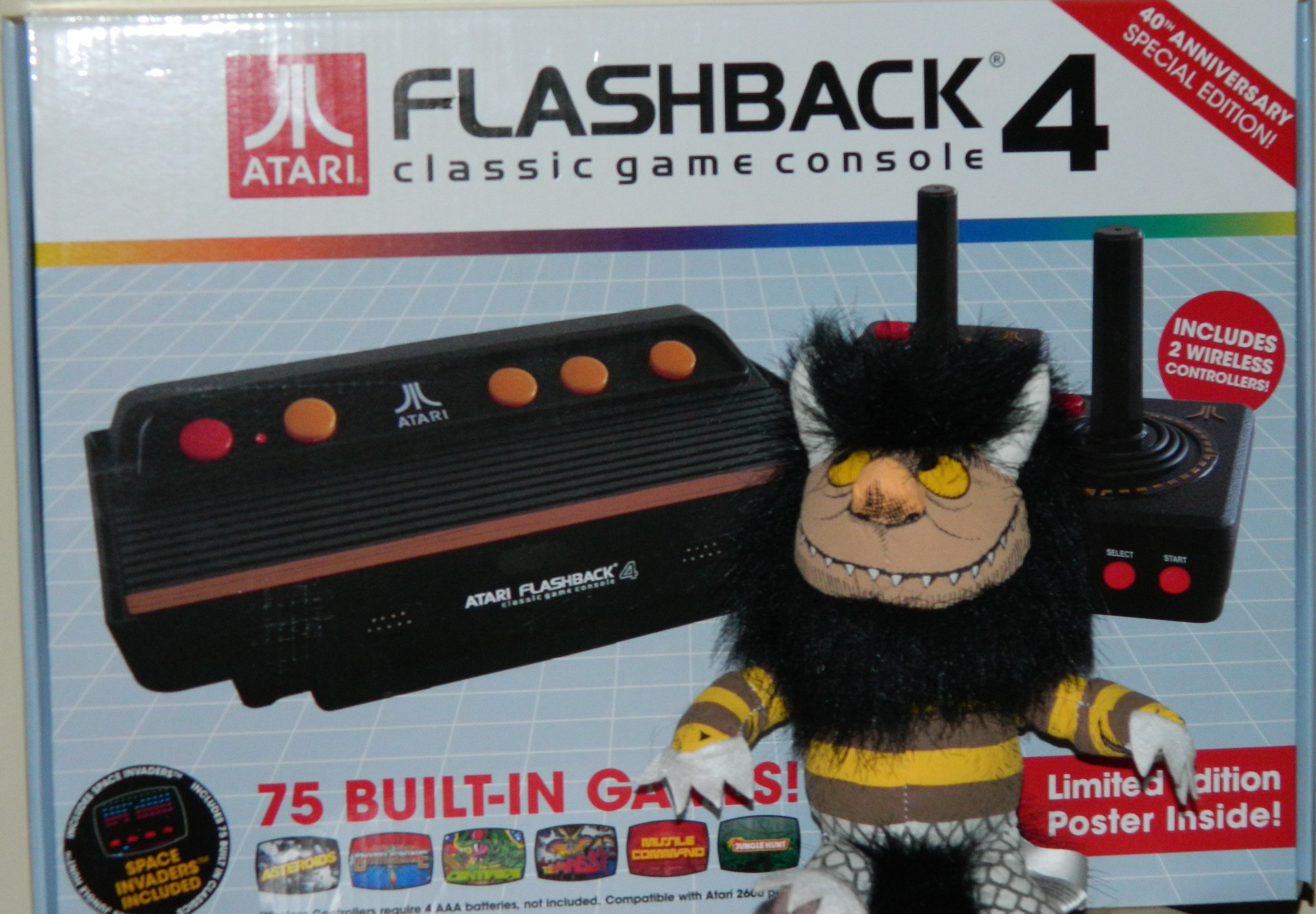
AtGames released the Flashback 4 in late 2012 with several improvements over the previous model.  It features new wireless controllers, support for paddles, and improved emulation.  It also includes seventy five games.  Secret Quest was removed from the game selection and sixteen games that were added.  The added games over the Flashback 3 are:  Black Jack, Breakout, Crystal Castles, Football, Front Line, Jungle Hunt, Polaris, Pong (Video Olympics), Return to Haunted House, Slot Machine, Slot Racers, Stellar Track, Street Racer, Space Invaders (special FB 4 edition, not 2600 version), Tempest, and Warlords.  Read more about the Flashback 4 in my previous posts.


Leave a comment

An Atari Flashback 3 or 4?

I have written a couple of posts about this year’s Atari Flashback 4, but some retailers still have Flashback 3’s for sale.  I have had a few questions about the differences between these models and which one is better.  So…let’s take a look…

Atari Flashback 3…

I purchased my Flashback 3 (FB 3) at a local retailer last year and, as of today, they still have these for sale for under $30.  The FB 3 comes with 60 built in games and two wired joysticks.  These joysticks have a softer feel than the original Atari CX-40’s, but have become my favorite for playing ‘one button’ games on my 7800.  In fact, the main reason that I purchased a FB 3 was to get a set of these joysticks.

As for the game selection on the FB 3, there are several classic games, including:  Asteroids, Battlezone, Centipede, Circus Atari, Gravitar, Missile Command, Video Pinball, and Yar’s Revenge.  It also includes several ‘prototype’ games not originally released by Atari:  Combat 2, Frog Pond, Saboteur, and Save Mary.

Wild for the FB 3!

Wild for the FB 3!

Atari Flashback 4…

I paid $40 for my Flashback 4 (FB4) the first week that it was available.  These were on sale for under $30 just before the holidays at a couple of stores in my area.  They are still available at several on-line merchants for between $40-50.

The FB 4 includes 75 games versus 60 on the FB 3.  The additional games are:  Black Jack, Breakout, Crystal Castles, Football, Front Line, Jungle Hunt, Polaris, Pong (Video Olympics), Return to Haunted House, Slot Machine, Slot Racers, Stellar Track, Street Racer, Space Invaders (special FB 4 edition, not 2600 version), Tempest, and Warlords.  I am not sure why, but one game that was included on the FB3, but not on the FB  4 was Secret Quest.

The addition of Front Line, Jungle Hunt, Pong, Space Invaders, and Warlords  justify the purchase of the FB 4 instead of the FB 3, but there are also a few other reasons to consider the FB 4. First, the FB 4 has wireless joysticks.  Although they are IR based, they work well and it is really nice to be able to sit across the room and be able to reset or change games.  The second reason to consider the FB4 is the ability to use paddle controllers.  Have you ever tried to play Super Breakout or Warlords with a joystick?  Third, the emulation is improved versus the FB 3.  It wasn’t too bad on the FB 3, but the emulation is ‘pretty darn good’ on the FB 4.

Wild for the FB 4!

Wild for the FB 4!

Recommendations…

Given the fifteen additional games, the ability to use paddles, and the wireless controllers, I would give the FB 4 a solid recommendation over the FB 3.  If you need some replacement joysticks for your classic Atari 2600 or 7800 and can find one for under $30, the FB 3 is still a great buy.

There is also a ‘Deluxe Edition’ of the FB 4 available for around $80.  For the extra $40, you get a set of paddle controllers and four additional posters.  If you can find one of these on sale for under $60, I would say that it would be worth the extra $$$ to get a set of paddles.

If you enjoy classic Atari 2600 games, both systems represent excellent value.  With that being said, the FB 4 gets my recommendation as a better system and a better value.


1 Comment

Funspot…

On US Route 3, just a short drive north of the Weirs Beach Boardwalk, Funspot was founded by Bob Lawton in 1952.  Funspot has been in its current location since 1964 and, in 2008, the Guinness Book of Records named Funspot the ‘World’s Largest Arcade’.  In addition to all of its arcade systems, Funspot is home to a nine hole miniature golf course, a ten lane bowling alley, a tavern, and a restaurant.  Most importantly, the third floor houses the ‘American Classic Arcade Museum’ and is a true 8-bit retro gamers dream come true.

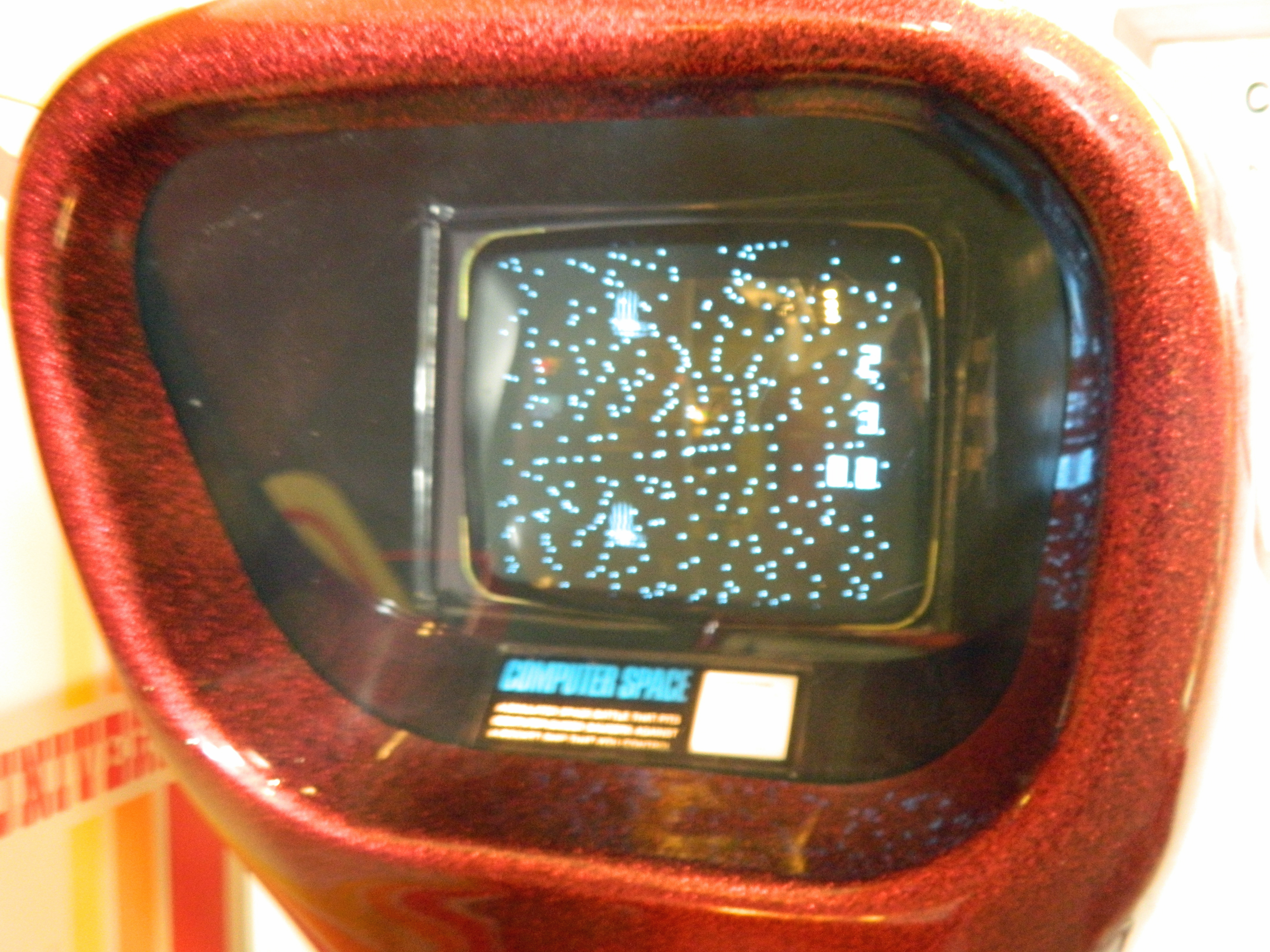
Computer Space

Computer Space

Funspot is a good two hour drive from my home, but what better to do on a sunny, but cold January day in New Hampshire?  Although I play my Atari game systems as much as I can, it had been a long time since I had been to an arcade with so many 8-bit systems.  As I entered the third floor of Funspot, I was amazed at their collection of systems.  It didn’t take me long to exchange some dollars for a cup full of tokens.  The biggest question was where to start?

Space Invaders

Space Invaders

I ended up starting with an old favorite…Space Invaders.  For not playing the arcade version for so many years, I was pretty happy with how I did.  In two or three hours, I managed to play the following games:  Berzerk, Centipede, Crossbow, Defender, Donkey Kong, Missile Command, Pac-Man Plus, Jr. Pac-Man, Space Invaders, Super Cobra, Zaxxon, and many others.  It was a total blast and, on some games I did well, but others were a real challenge.  You get so used to playing with your joysticks at home, that some of these games are a real adjustment.  I was completely useless on Defender and just could not manage the hand-eye coordination required for the arcade version.

Pac-Man Plus

Pac-Man Plus

What was really fun was to see how well many of these games translate to the Atari 2600 and, especially, the 7800.  When I write about games, I always take a look at photos and videos of real arcade systems, but nothing beats being able to play the real thing!

If you are reading this blog, then you enjoy retro gaming.  If you happen to travel to or live in New England, you owe it to yourself to add a visit to Funspot to your itinerary.   For twenty dollars or less, you can have an afternoon of fun that will be hard to match anywhere else.  Funspot has so many 8-bit arcade games, that the best thing to do is to refer you to their website, so that you can read the list for yourself.

Oh, and as a final note…Funspot founder Bob Lawton will be featured this Wednesday evening (January 9th) on American Restoration.

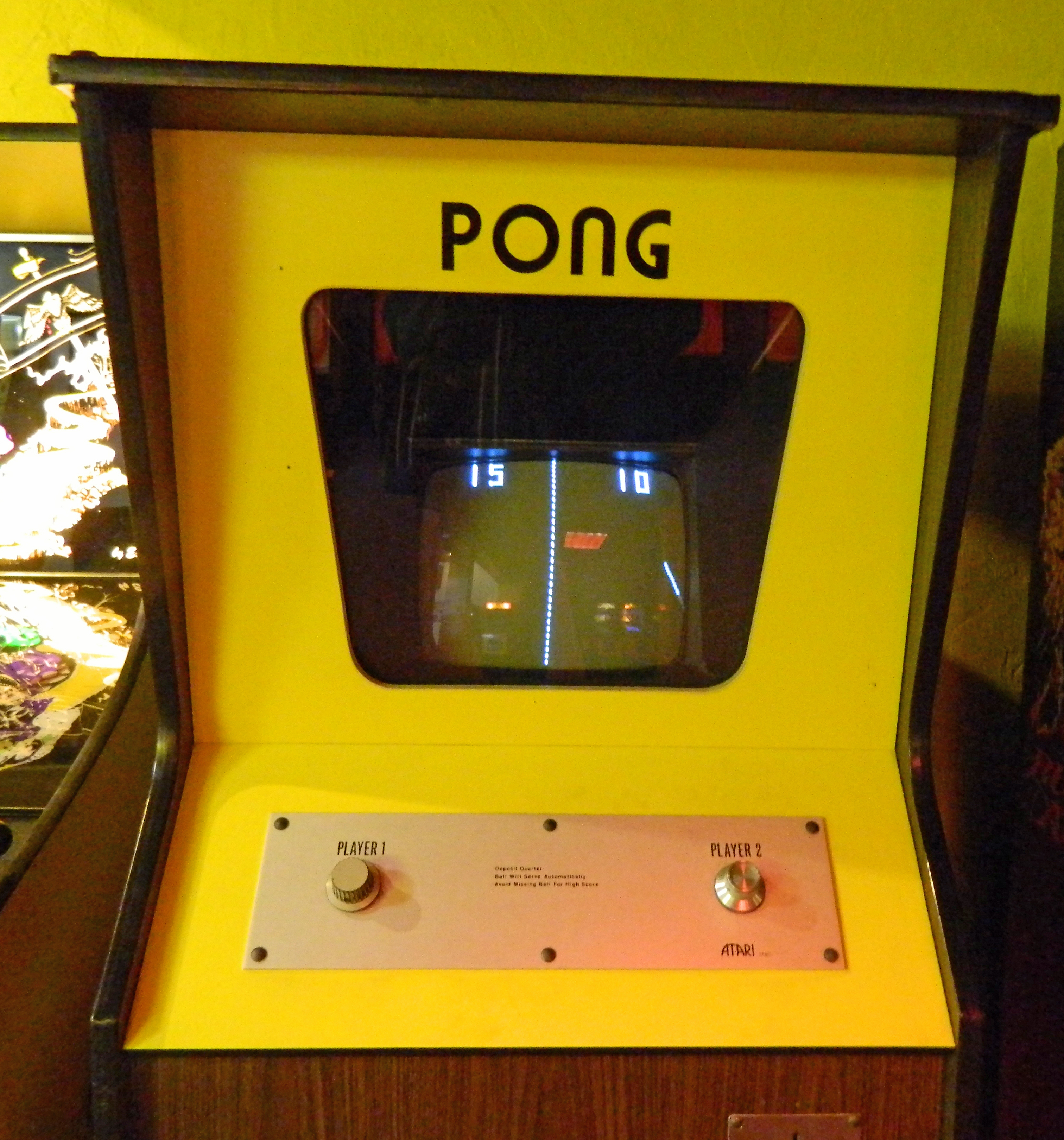
Pong

Pong


Leave a comment

Atari 7800 Pac-Man games…

The only officially released Pac-Man game for the 7800 was Ms. Pac-Man, but thanks to Curt Vendel and Bob DeCrescenzo, we now have a complete library of Pac-Man games for the Atari 7800.

Ms. Pac-Man…

Programmed by General Computer Corporation as part of the first set of games for the 7800’s release in 1984, Ms. Pac-Man is an excellent conversion.  Ms. Pac-Man demonstrates the strength of the 7800 as one of the best home consoles for arcade ports.   This game has great graphics and pretty much has it all…title screen, intermissions, four different mazes, and four flicker free pesky ghosts!  Better yet, since millions of copies of this game were produced, a boxed copy can be had for less than ten dollars.  The only thing that should stop you from picking up a copy for your collection is whether or not you decide to purchase the Pac-Man Collection described next.

Pac-Man…

It is hard to believe that Atari never developed a version of Pac-Man for the 7800.  Fortunately Bob ‘PacManPlus’ DeCrescenzo has come to the rescue.  Speaking of rescue, in 1996 Curt Vendel found the source code for Ms. Pac-Man in a dumpster.   It seems that in Atari’s haste to ‘go out of business’, they inadvertently discarded the source code for several games.  Through Curt’s efforts, this source code was preserved and released to the public domain.  Bob used this source code to develop several new Pac-Man games for the 7800.  Originally, Bob developed one game at a time, but already had the idea to put them together as a collection.  Included in Bob’s Pac-Man collection are:

  • Pac-Man
  • Pac-Man Plus
  • Ms. Pac-Man
  • Ms. Pac-Attack
  • Hangly Man
  • Puck Man
  • Random Mazes

Bob’s collection is about as arcade perfect as can be done on a home system.  He even ‘tweaked’ the already pretty awesome Ms. Pac-Man to be even better.  The Pac-Man Collection has been one of the best selling carts at AtariAge since Bob put it together.  If you have a 7800 you need to have this cart in your collection…don’t hesitate any longer!

Super Pac-Man…

After he released his Pac-Man Collection, Bob turned his attention to creating a version of Super Pac-Man for the 7800.  Before I started this thread on Pac-Man games, I really didn’t know much about Super Pac-Man and I don’t remember ever playing it in an arcade.  I didn’t know what to expect when I ordered my Super Pac-Man cart from AtariAge, but I have to say that I really like this game.   As always, Bob took care to make as accurate a port as possible and his 7800 version is a blast to play.  The colors are bright, all of the arcade features are included, and this game provides some variety from the ‘standard’ Pac-Man format.  If you are a fan of Super Pac-Man, then this cart should be in your 7800 collection!

Jr. Pac-Man…

This one started out as a fairly elaborate April fool’s joke on the AtariAge forum back in 2009.  Bob DeCrescenzo had been working on Jr. Pac-Man and got a few friends to go along with the hoax that a prototype cart of Jr. Pac-Man had been discovered.  The joke went pretty well until some discovered Bob’s initials in a line of code.

Jr. Pac-Man for the 7800 is another Bob classic and has become my favorite Pac-Man game.  Like the arcade (and unlike the 2600 version), the screen scrolls horizontally, there are six power pills, and the fruits have been changed.  As the fruit bounces, it changes the dots into larger, more valuable dots, but can also destroy the power pills.  Since this can be happening off-screen, there is some additional strategy to Jr. Pac-Man than other versions.

Jr. Pac-Man is another awesome game and is available on cart from AtariAge.

Thanks to GCC, Curt Vendel, AtariAge and, most importantly, Bob DeCrescenzo, almost every variation of Pac-Man is available to be played on the 7800.  I asked Bob which version was his favorite…can you guess what he said?  Considering that he goes by the handle ‘PacManPlus’, his answer should be easy to guess!

Pac-Man gamesfor the 7800

Pac-Man games
for the 7800


1 Comment

Atari 2600 Pac-Man games…

There were three officially released Pac-Man games for the Atari 2600.  In this post, I will discuss these as well as some homebrews and hacks.  Be sure to read my previous post about the arcade versions of these games.

Pac-Man…

Released by Atari in early 1992, Pac-Man ended up being the best selling game ever for the 2600.  It went on to sell more than seven million copies at $37.95.  That was a heck of a lot of money back in 1982 and would be more than $80 today.  The 2600 version was programmed by Tod Frye who was one of the first Atari programmers to receive royalties.  It has been reported that Tod was paid more than $1 million for his efforts.   Atari spent more than $1.5 million on advertising and marketing for Pac-Man.

Unfortunately, the game was horrible and it looked nothing like the arcade version.  The maze was nothing like the arcade maze and since when did Pac-Man grow an eye?  Pac-Man’s orientation doesn’t change when he changes direction and there is a tremendous amount of flicker with the ghosts.  Supposedly, there were better prototypes that had been developed, but Atari wanted to squeeze the game onto a 4K cartridge to save money.

Pac-man did sell seven million copies, but Atari had produced twelve million and, after playing the game, many customers returned it for a refund.  Thus, Atari ended up with more than five million unsold copies.   Unless you need to have this game for some collecting reasons, don’t even waste one dollar of your money on Pac-Man!

Ms. Pac-Man…

Released by Atari less than a year after Pac-Man, Ms. Pac-Man turned out to be an excellent port to the 2600.  Maybe the reason why is that it was actually programmed not by Atari, but by Mike Horowitz and Josh Littlefield of General Computer Corp (GCC).   Mike and Josh managed to get pretty close to that arcade experience, given the limitations of the 2600.  In fact, they pretty much have it all…four ghosts, bouncing fruit, animated title screen, four different mazes, and Ms. Pac-Man looks like Ms. Pac-Man.  There is still some flicker, but much improved over Pac-Man.   Ms. Pac-Man uses an 8K cartridge, versus 4K, and it is worth every K!

Ms. Pac-Man belongs in every 2600 collection and is the basis for several hacks.

Jr. Pac-Man…

Developed in 1984, but not released until 1987, Jr. Pac-Man was also programmed for Atari by GCC.  This time, Ava-Robin Cohen did the programming and she did an awesome job.  Once again, almost all of the arcade features are present in the 2600 version and it is a blast to play.  The biggest difference between the arcade and the 2600 version is the scrolling.  The 2600 version scrolls vertically, instead of horizontally.   Other than that, it is all there…Junior, the ghosts, candies, scrolling screen, etc.!

Pac-Man Arcade…

Using the Ms. Pac-Man code as a starting point, Rob Kudla created the Pac-Man that Atari should have done in 1982.  Rob extensively hacked Ms. Pac-Man to create a great version of Pac-Man for the 2600.  The mazes, sounds, graphics, and gameplay are all much closer to the arcade than Atari’s original version.  Photos of the game and several review comments are posted, so be sure to check out AtariAge to learn more about Pac-Man Arcade.

Pac-Man Plus…

Using Rob Kudla’s Pac-Man Arcade as a starting point, Bob ‘PacManPlus’ DeCrescenzo did some additional hacks to create a ‘plus’ version of Pac-Man.  Bob changed the mazes to be green, changed the ghosts to have leafs on their heads, and changed the fruits to match the bonus items in the arcade version.  I don’t think that this variation has been made available on a cart, so you will need a multi-cart or emulator to play to version of Pac-Man Plus.

Pac-Man 4K…

Dennis Debro set out to make a 2600 Pac-Mac version, as close to the arcade as possible, using only a 4K cartridge.   Recently his Pac-Man 4K has become available from the AtariAge store.  For a 4K effort, Dennis has done an amazing job.  The maze, graphics, and gameplay are just about as close as you can get to the arcade, especially given the 4K size of the game.  My only feedback is about the amount of flicker for Pac-Man and the ghosts.  Photos and a video of Pac-Man 4K are posted at AtariAge, so go check them out.  Flicker aside, Dennis has shown what Atari could have done with a 4K limit for Pac-Man!

Hack’em/Hangly Man…

At one point, the folks at Ebivision had developed a Pac-Man game for the 2600.  Due to licensing issues, they instead turned it into Pesco.   Nukey Shay took their original Pac-man code and has made many changes and updates to create one darn good Pac-Man for the 2600.  He has even included the Plus mode and is working on a Ms. Pac-Man game as well.  To read more about his efforts, see his thread at AtariAge.

There have been plenty more hacks of Pac-Man games for the 2600, but I have tried to cover the most significant ones.  This actually took a lot more time and research than I thought it would!  Next up…Pac-Man games for the Atari 7800…for now, I need to go play some Pac-Man!!!

PacMan for the 2600

Pac-Man for the 2600


3 Comments

Pac-Man the series…

In my next few posts, I am going to write about Pac-Man, the spin offs, and ports to the Atari 2600 and 7800 systems.

Pac-Man…

Pac-Man is probably the most well known video game in history.  It was developed by Namco in 1979 and distributed in the United States by Midway.  In Japan (and in parts of Europe) the game was known as Puck Man.  Pac-Man was developed over a period of about eighteen months by Namco employee Toru Iwatani.  When Pac-Man was first released in Japan, it was not a hit as Space Invaders continued to dominate the arcade scene.  When Pac-Man was released in the US, everything changed.  It seemed that the American public welcomed the change from Space Invaders and the seemingly endless number of arcade space shooters.  Midway sold more than 350,000 Pac-Man arcade units and it became an even bigger hit than Atari’s Asteroids.

The game of Pac-Man is based around a pretty simple concept.  The player must control Pac-Man and have him eat all of the dots in the maze, while avoiding the ghosts.  There are four power pills (at the corners of the maze) which give Pac-Man invincibility and the ability to eat the ghosts.  Each ghost eaten is more valuable.  The ghosts (Blinky, Pinky, Inky, and Clyde), which all have different personalities, get re-incarnated when their eyes return to the box at the center of the screen.  As the game progresses, the time period of invincibility becomes shorter.  Additionally, fruits appear periodically and, when eaten, give the player bonus points.

Most gamers don’t know that it is impossible to finish a Pac-Man game.  There are 256 levels, but there is a bug in the arcade ROM that prevents completion.  Normally there are seven fruits displayed across the bottom of the screen, but an error in programming causes 256 fruits to be displayed on the 256th level, destroying the right hand side of the maze.

Due to its popularity, Pac-Man was ported to almost every home console of the era including the Atari 2600, 5200, and 8-bit systems.  It was also ported to the Intellivision, NES, and Commodore 64.

Ms. Pac-Man…

Believe it or not, Ms. Pac-Man started out as Crazy Otto.  General Computer Corporation (GCC) had developed an enhancement kit for Missile Command arcade units.  This didn’t make Atari very happy and they sued GCC.  The suit was settled when GCC agreed not sell any more enhancement kits without the agreement of the original manufacturer.  GCC also agreed to collaborate with Atari on some future projects.   GCC had developed an enhancement kit for Pac-man called Crazy Otto.  Per the agreement with Atari, they were compelled to show it to Midway.  Midway ended up liking it so much that they bought it from GCC and re-worked it into what is now known as Ms. Pac-Man.

Ms. Pac-Man became a monster hit for Midway when it was released in 1982.  In fact, Ms. Pac-Man became one of the most popular arcade games of all time.  It was the first to feature a female character and Midway sold more than 100,000 Ms. Pac-Man arcade units.  Unfortunately, Midway did not obtain authorization from Namco for the development and release of Ms. Pac-Man.  Fortunately, Ms. Pac-Man was so popular that Namco did reach agreements with Midway and GCC and Ms. Pac-Mac  became an officially licensed Namco game.

Like Pac-man, Ms. Pac-Man was ported to a number of home consoles including the Atari 2600, 5200, 7800, and 8-bit systems.   It was also ported to the NES, Commodore 64, and Apple II.

 Super Pac-Man…

This is the third game in the series and, unlike Ms. Pac-Man, was actually developed by Namco.  Super Pac-Man becomes ‘super’ by eating one of the two ‘super’ pellets.  When ‘super’, he is larger, faster and can eat through doors.  When ‘super’, he is also invincible to the ghosts.  When normal, he must eat the keys which open the doors to allow him to eat the fruits.

The Super Pac-Man concept was quite a deviation from Pac-Man and Ms. Pac-Man and was only a moderate success.  It was also developed to run on a Motorola 6809 CPU versus the Z80’s used the the previous Pac-Man arcade units.

Due to its limited success it was only ported to the Atari 5200, but was never released by Atari.

Pac-Man Plus…

Pac-Man Plus was released by Midway in 1982 and, like Ms. Pac-Man, it was not authorized by Namco.  Pac-Man Plus is similar to Pac-Man with the biggest differences being the green (versus blue) maze and the fruits being replaced by ‘other’ objects such as beverages.  Additionally, eating a power pill sometimes causes unexpected results such as making the maze invisible or only turning three of the four ghosts blue.

Because Pac-Man Plus was released just before the ‘Video game collapse of 1983′, it was never officially ported to any home consoles.  It was reasonably popular in the arcades and, actually, outsold Super Pac-Man.

Midway also developed a Ms. Pac-Man Plus arcade system which was identical to Ms. Pac-Man, only with different mazes.

Jr. Pac-Man…

Jr. Pac-Man was another version developed by Bally Midway without permission from Namco.  Jr. was closer to the original Pac-Man format than Super Pac-Man.  The biggest change is that the maze is now twice as large and, as Jr. moves, the maze will pan across the screen horizontally.  There are also six power pills instead of four and, due to the scrolling mazes, there are no tunnels.  Jr. Pac-Man also has the added challenge of things happening off-screen.  Additionally, the toy candies (versus fruits) transform the dots and make them more valuable to eat, but they can also destroy the power pills.

Released in 1983, Jr. Pac-Man was only a moderate success.  It was ported to the Atari 2600, 5200, and 8-bit systems, but only the 2600 version was released.  Since Jr. Pac-Man was developed Bally Midway, the arcade systems run on Z80 CPU’s like Pac-Man and Ms. Pac-Man.

Pac-Man Aracde Systems

Pac-Man Aracde Systems

Next…

In my next post, I will write about the Atari 2600 ports of the Pac-Man series…