Retro Game Guy

It's the 1980's again!


1 Comment

Berzerk…

Berzerk is a 1980 video game developed by Stern Electronics of Chicago.  Supposedly Alan McNeil, the designer of Berzerk, had a dream about a black and white video game involving fighting robots.  During the development of Berzerk, Defender was released and the decision was made to release Berzerk in color instead of B&W.  A few early units were, supposedly, released in B&W with color overlays.   The color units were produced in two distinct batches with the second batch having more variety in the colors of the robots and the number of bullets that they fire.  The Berzerk arcade systems are based around a Z80 CPU and it is one of the first video games to feature speech synthesis.  This may not seem like a big deal in 2013, but it was really amazing in 1980.  The first time anyone played Berzerk, they had to be amazed to hear the game talk to them!

The concept of Berzerk is pretty simple…the player is a humanoid in a maze with a bunch of killer robots.  To survive, you must shoot the robots before they shoot you.  You also have to avoid running into the robots, the electrified walls, and Evil Otto.  Evil Otto adds a significant amount of complexity to the game as you must avoid him as you can not kill him.  Alan supposedly named Evil Otto after the security chief at a previous employer.  The robots in Berzerk are not the ‘sharpest tools in the shed’ as they have a tendency to kill themselves by running into the walls or each other.  Although the concept of the game is simple,  players would find themselves putting quarter after quarter into the game.   Berzerk was the first popular ‘shoot em up’ video game and all of today’s popular shooter games can trace their roots back to 1980.  Berzerk was ported to the Vectrex and the Atari 2600 and 5200 consoles.

Berzerk at Funspot

Berzerk at Funspot

2600 Version…

The 2600 version of Berzerk was released in 1982 and was a smash hit.  Berzerk’s simple graphics were faithfully replicated on the 2600 and the game play was almost identical to the arcade.  Atari included 12 variations including ones with and without Evil Otto, non-shooting Robots, and even one where Evil Otto can be shot and will disappear for a few seconds.  I fondly remember playing Berzerk over and  over on my Sears Video Arcade (Atari 2600) in the early 80’s.  It is a fantastic game and there was something cool about the green label and box.  There was one big thing missing, however, from Atari’s 2600 version…voice synthesis.  Back in 1982, most of us figured that this just could not be done on a 2600.

In 2002, Mike Mika proved this wrong when he developed an improved version of Berzerk featuring voice synthesis.  In ‘Berzerk Voice Enhanced‘, Mike also improved the graphics to make them more closely resemble the arcade.  At various points in Mike’s version you will hear ‘intruder alert!’, ‘chicken, fight like a robot’, and ‘humanoid must not escape’.   Berzerk is a great game for the 2600, but Berzerk VE is an outstanding game that belongs in every 2600 collection!

5200 Version…

The 5200 version of Berzerk was released in 1983 and became an instant classic.  Like its 2600 cousin, the 5200 version faithfully replicates the arcade graphics and game play.  The 5200 version takes it to the next level and features full voice synthesis.  Mike’s Berzerk VE for the 2600 is pretty awesome, but the 5200 version is one step better.  The voice synthesis is tied to the game play so that when Evil Otto is about to appear, you will hear ‘intruder alert!’.  The 5200 port is one of the best arcade conversions in the 5200 library and belongs in every 5200 collection.  The only thing missing is a coin slot and ‘coins detected in pocket’.

7800 Version…

Sadly, no 7800 version of Berzerk was developed.  Fortunately, the 7800 plays almost all 2600 games and you can play Berzerk or Berzerk VE on your 7800.  One day, maybe, some enterprising homebrewer will port Berzerk to the 7800 with full voice synthesis.  Until then, you can enjoy the regular 2600 version or the VE version.

Frenzy…

In 1982, Stern followed up Berzerk with Frenzy.  Frenzy was similar, but a little more difficult than Berzerk.  At least in Frenzy, however, it is possible to kill Evil Otto.  Frenzy was ported to the Colecovision, but not to any Atari home consoles.  A while ago, one homebrew developer was thinking about porting Frenzy to the 7800.  Let’s hope that one day this comes to fruition.

Wild for Berzerk!
Wild for Berzerk!


1 Comment

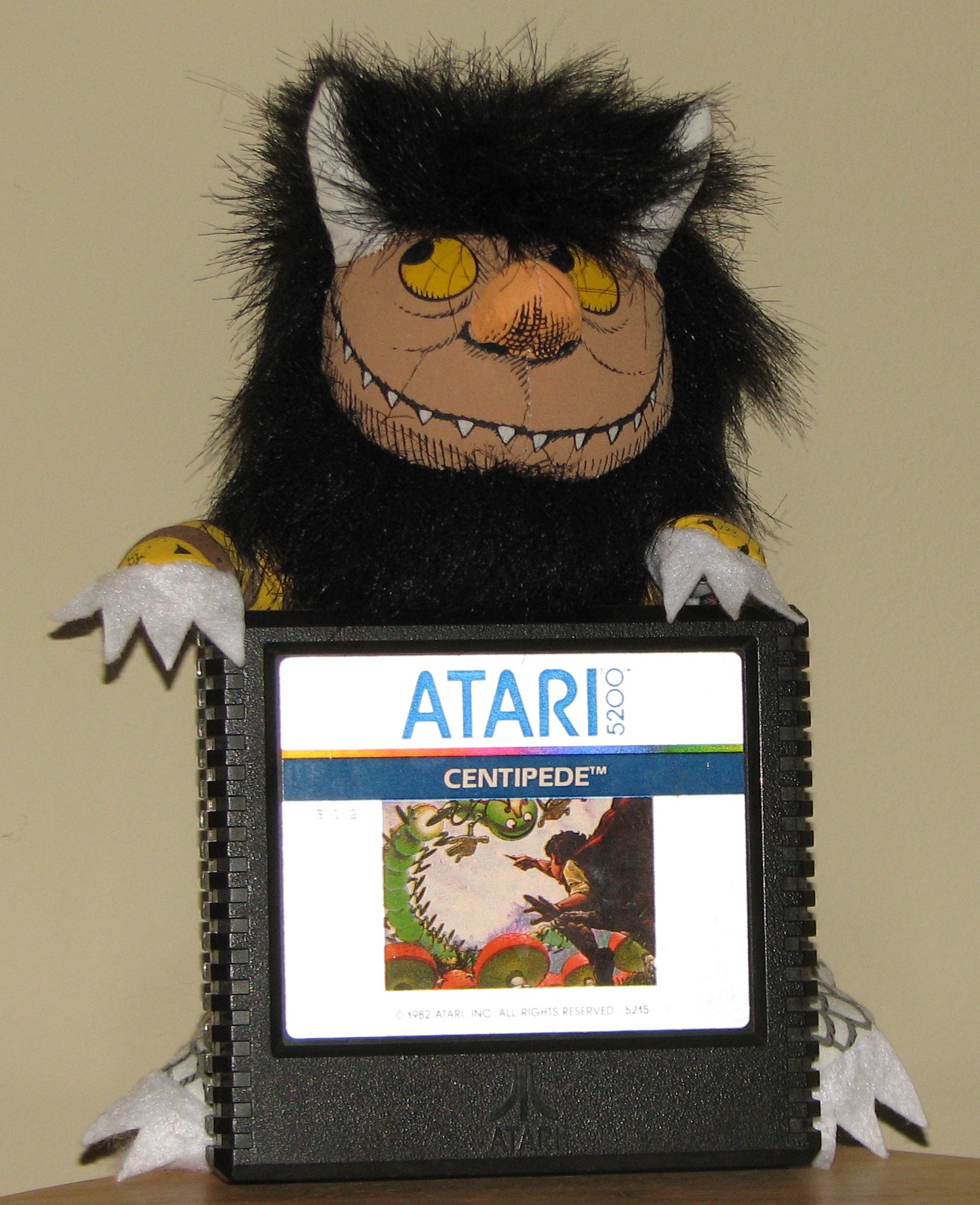
Centipede…

Centipede is a 1980 video game developed by Atari.  It is notable in that it was one of the few video games that was co-developed by a woman (Dona Bailey) and, also had a large female following.  Centipede was a monster hit for Atari and it could be found in nearly every arcade in the early 80’s.  Centipede is based on the standard Atari hardware of the era with a single 6502 CPU, a single Pokey chip,  and a 16 color CRT.

The concept of the game is pretty straight forward.  The centipede starts at the top of the screen and moves down a level every time it encounters a mushroom.  You must use your wand (blaster) to shoot the centipede before it gets to you.   If you hit the centipede in a center section, it will split in two.  You must also defend yourself from spiders that enter from the sides and fleas that fall from the top.  Scorpions periodically run across the screen and ‘poison’ any mushrooms that they contact.  If the centipede contacts a poison mushroom, it will ‘fall’ to the bottom of the screen.

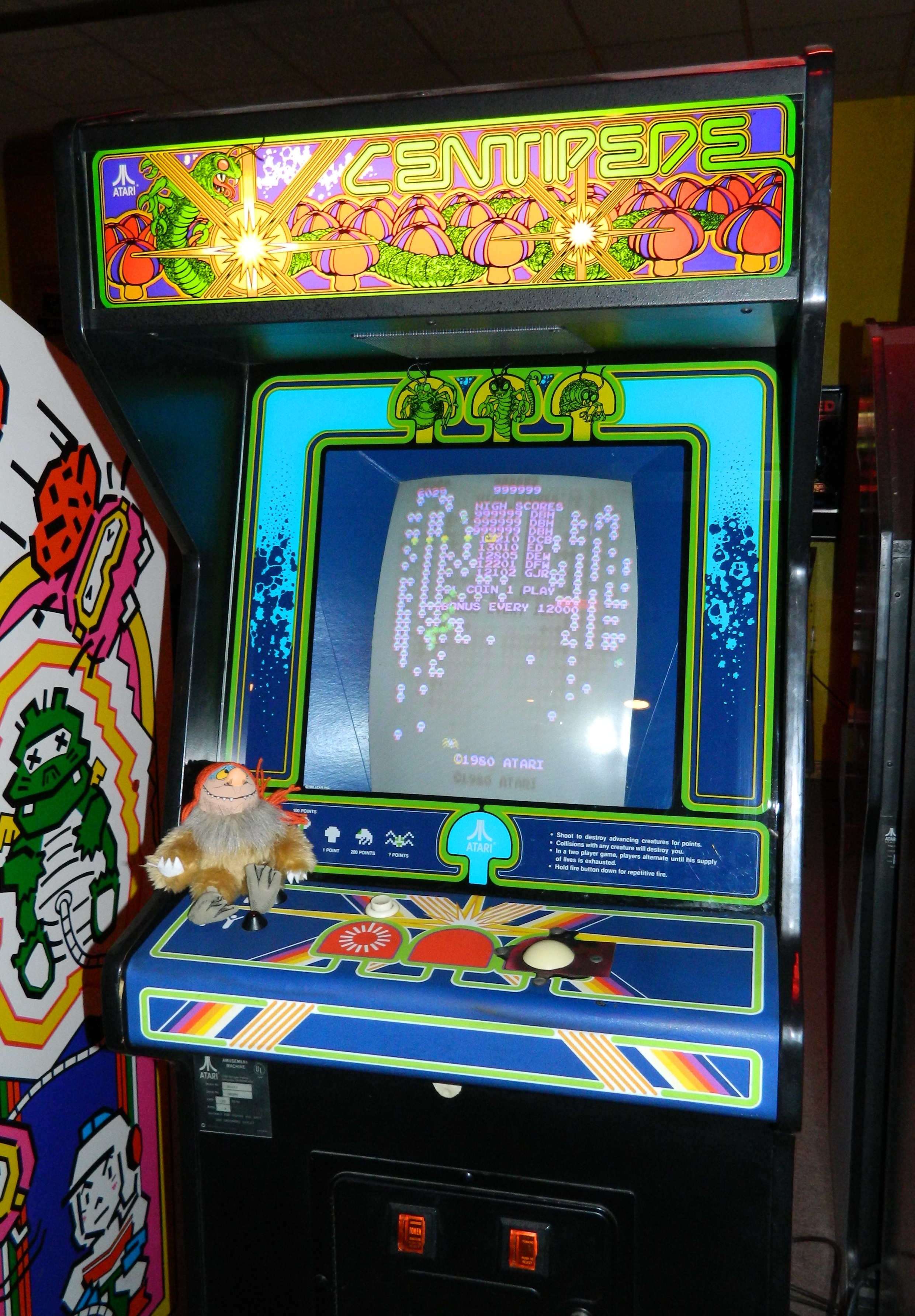
Centipede at Funspot

Centipede at Funspot

Centipede was ported to a number of home consoles and computers including the Apple II, the Commodore 64, and the Atari 800 and the Atari 2600, 5200, and 7800 consoles.  In fact, it is one of the few games to be ported to all 4 of Atari’s 8-bit game systems.

In 1982, Atari released Centipede for the VCS/2600 and, when you power up your 2600 with a Centipede cartridge installed, you will be amazed with the start screen…you will think that you are about to see an amazing graphical port for the 2600.  Unfortunately, the start screen is as far as the amazing graphics go.  The game graphics are disappointing as the mushrooms have become simple square blocks.   As far as the game play goes, however, the 2600 version has it all…mushrooms, spiders, fleas, and scorpions.  It plays as close to the arcade version as any 2600 port.  In fact, Centipede is one of the top games for the 2600!

When the 5200 SuperSystem was introduced in 1982, Centipede was one of the early releases.  Given that a Centipede arcade unit has the same basic CPU and sound chips as a 5200, it should be no surprise that the 5200 version is a classic port.  Like the 2600 version, all of the arcade elements are present, but this time the graphics and sound are spot on.  Control with a standard 5200 joystick is solid, but the 5200 version supports the use of the Trak-ball unit.  Centipede is one of the top games available for the 5200.

In 1987, Atari released Centipede for the 7800 ProSystem.  Even though the 7800 lacks the sound capability of the 4 channel Pokey chip, Centipede is well executed with a nice start screen, great graphics, and more than adequate sound.   The only thing negative to say about the 7800 graphics is the box that is drawn around the screen.   The 7800 version makes up for any shortcomings with neat two player modes.  Two players can alternate turns, play against each other (at the same time), or play together as a team.

It is hard to say which version of Centipede is the best port.  The two player modes in the 7800 version make it a blast to play with a friend, but I give a slight edge to the 5200 version for its accuracy to the arcade version.  No matter which Atari home console you have, a copy of Centipede belongs in your game collection!

Wild for Centipede!

Wild for Centipede!


Leave a comment

Atari Flashback 1, a review…

It may seem kind of silly to review a system from 2004 that is no longer being produced, but I think it is worthwhile as a base of comparison to the newer units.

I was able to purchase my Flashback 1 for less than $10 and it came complete with the base unit, power supply, two controllers, box, and a manual.  Having only seen pictures of these until this unit arrived, I was surprised at how small it is.  The Flashback 1 looks like a miniature Atari 7800 and is about half the size of the subsequent Flashback units.

The Flashback concept was developed by Curt Vendel of Syzygy (formally Legacy Engineering).  Atari agreed to produce the unit, but wanted to have it ready for the 2004 holiday season.  This only gave Curt about ten weeks to design the unit and he went with a design that is based on a ‘NES on a chip’.  Since the system is based on a NES chip, all games had to be ‘ported’ and a mixture of 2600 and 7800 games are included:

2600:  Adventure, Air-Sea Battle, Battlezone, Breakout, Canyon Bomber, Crystal Castles, Gravitar, Haunted House, Millipede, Saboteur, Skydiver, Solaris, Sprintmaster, Warlords, and Yars’ Revenge

7800:  Asteroids, Centipede, Desert Falcon, Food Fight, and Planet Smashers

At first I thought it would be cool to see how the five 7800 games translated, but I was soon disappointed.  Centipede isn’t too bad but Asteroids didn’t make the transition well at all.  Also, I find the 7800 game selection puzzling…Asteroids, Centipede, and Food Fight are popular titles, but Desert Falcon and Planet Smashers are less well known.  In fact, Planet Smashers is one of the rarer 7800 titles and, also, one of the poorest rated.  Given the quality of the 7800 ports, I am not sure that it would have mattered, but Dig Dug, Ms. Pac-man, or Pole Position II would have been better choices.

I am happy to say that the 2600 ports are much better.  Of course, more effort has been put in over the years to port and emulate the 2600, so I guess that this should have been expected.  The exception is Battlezone…this port is horrible and hardly worth playing.  Millipede, on the other hand, is a blast to play on the Flashback.  Also, the Flashback 1 introduced the concept of releasing prototype games and included the previously unreleased Saboteur.

Breakout and Warlords had to be modified to use the Flashback joysticks and I wasn’t expecting much.  These were a pleasant surprise and are very playable.

It should be noted that the Flashback 1 joysticks are not usable with standard Atari (or other Flashback units) as they are wired differently.

Given that we know that the Flashback 1 was a ‘rushed’ effort, I guess it would be a cliche to say that it seems half polished.  Unless you are an Atari collector and need to have one of these, I would recommend skipping the Flashback 1 in favor of a Flashback 2, 2+, or the newer Flashback 4.

The Flashback 1 is an important piece of Atari history in that it marked the return of Atari to the console market.  It also sold well enough to convince Atari to proceed with the Flashback 2.  As I will discuss in a future post, the Flashback 2 is the system that Curt really wanted to build in the first place.

Speaking of Curt, he is going to have a significant surgery this week and I want to wish him the best of luck and a speedy recovery!

Atari Flashback 1

Atari Flashback 1


1 Comment

Funspot…

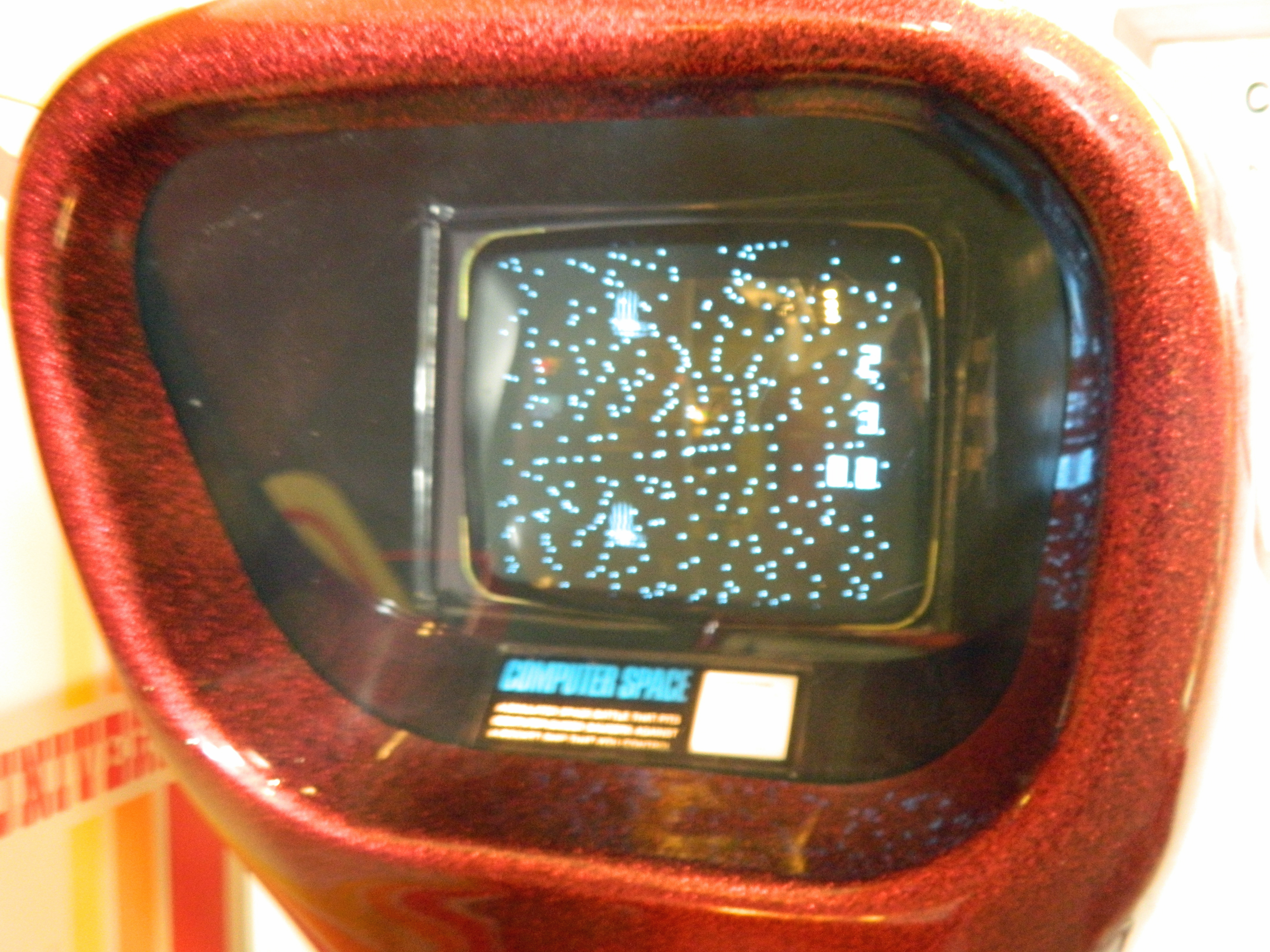
On US Route 3, just a short drive north of the Weirs Beach Boardwalk, Funspot was founded by Bob Lawton in 1952.  Funspot has been in its current location since 1964 and, in 2008, the Guinness Book of Records named Funspot the ‘World’s Largest Arcade’.  In addition to all of its arcade systems, Funspot is home to a nine hole miniature golf course, a ten lane bowling alley, a tavern, and a restaurant.  Most importantly, the third floor houses the ‘American Classic Arcade Museum’ and is a true 8-bit retro gamers dream come true.

Computer Space

Computer Space

Funspot is a good two hour drive from my home, but what better to do on a sunny, but cold January day in New Hampshire?  Although I play my Atari game systems as much as I can, it had been a long time since I had been to an arcade with so many 8-bit systems.  As I entered the third floor of Funspot, I was amazed at their collection of systems.  It didn’t take me long to exchange some dollars for a cup full of tokens.  The biggest question was where to start?

Space Invaders

Space Invaders

I ended up starting with an old favorite…Space Invaders.  For not playing the arcade version for so many years, I was pretty happy with how I did.  In two or three hours, I managed to play the following games:  Berzerk, Centipede, Crossbow, Defender, Donkey Kong, Missile Command, Pac-Man Plus, Jr. Pac-Man, Space Invaders, Super Cobra, Zaxxon, and many others.  It was a total blast and, on some games I did well, but others were a real challenge.  You get so used to playing with your joysticks at home, that some of these games are a real adjustment.  I was completely useless on Defender and just could not manage the hand-eye coordination required for the arcade version.

Pac-Man Plus

Pac-Man Plus

What was really fun was to see how well many of these games translate to the Atari 2600 and, especially, the 7800.  When I write about games, I always take a look at photos and videos of real arcade systems, but nothing beats being able to play the real thing!

If you are reading this blog, then you enjoy retro gaming.  If you happen to travel to or live in New England, you owe it to yourself to add a visit to Funspot to your itinerary.   For twenty dollars or less, you can have an afternoon of fun that will be hard to match anywhere else.  Funspot has so many 8-bit arcade games, that the best thing to do is to refer you to their website, so that you can read the list for yourself.

Oh, and as a final note…Funspot founder Bob Lawton will be featured this Wednesday evening (January 9th) on American Restoration.

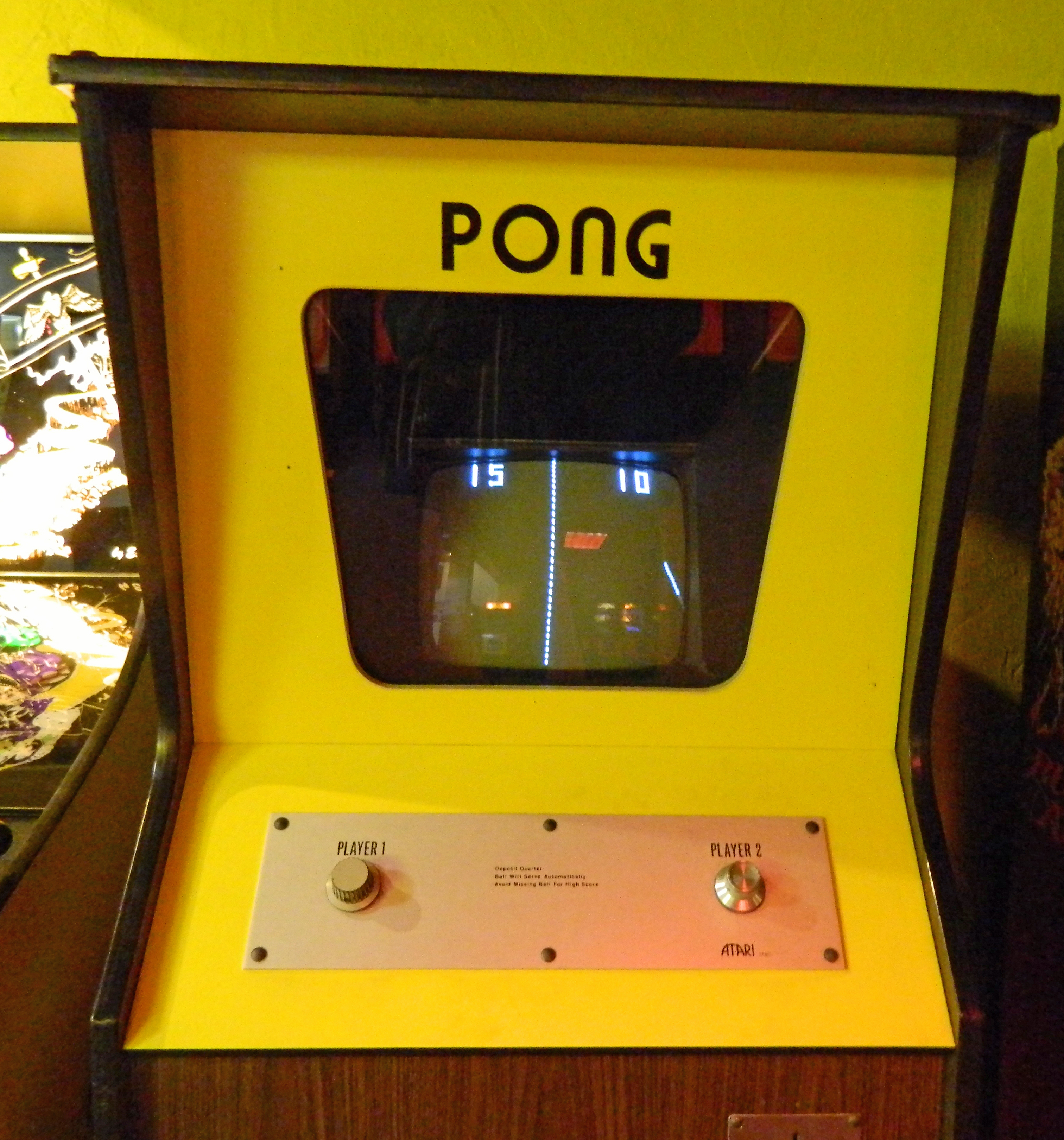
Pong

Pong


Leave a comment

Atari 7800 Pac-Man games…

The only officially released Pac-Man game for the 7800 was Ms. Pac-Man, but thanks to Curt Vendel and Bob DeCrescenzo, we now have a complete library of Pac-Man games for the Atari 7800.

Ms. Pac-Man…

Programmed by General Computer Corporation as part of the first set of games for the 7800’s release in 1984, Ms. Pac-Man is an excellent conversion.  Ms. Pac-Man demonstrates the strength of the 7800 as one of the best home consoles for arcade ports.   This game has great graphics and pretty much has it all…title screen, intermissions, four different mazes, and four flicker free pesky ghosts!  Better yet, since millions of copies of this game were produced, a boxed copy can be had for less than ten dollars.  The only thing that should stop you from picking up a copy for your collection is whether or not you decide to purchase the Pac-Man Collection described next.

Pac-Man…

It is hard to believe that Atari never developed a version of Pac-Man for the 7800.  Fortunately Bob ‘PacManPlus’ DeCrescenzo has come to the rescue.  Speaking of rescue, in 1996 Curt Vendel found the source code for Ms. Pac-Man in a dumpster.   It seems that in Atari’s haste to ‘go out of business’, they inadvertently discarded the source code for several games.  Through Curt’s efforts, this source code was preserved and released to the public domain.  Bob used this source code to develop several new Pac-Man games for the 7800.  Originally, Bob developed one game at a time, but already had the idea to put them together as a collection.  Included in Bob’s Pac-Man collection are:

  • Pac-Man
  • Pac-Man Plus
  • Ms. Pac-Man
  • Ms. Pac-Attack
  • Hangly Man
  • Puck Man
  • Random Mazes

Bob’s collection is about as arcade perfect as can be done on a home system.  He even ‘tweaked’ the already pretty awesome Ms. Pac-Man to be even better.  The Pac-Man Collection has been one of the best selling carts at AtariAge since Bob put it together.  If you have a 7800 you need to have this cart in your collection…don’t hesitate any longer!

Super Pac-Man…

After he released his Pac-Man Collection, Bob turned his attention to creating a version of Super Pac-Man for the 7800.  Before I started this thread on Pac-Man games, I really didn’t know much about Super Pac-Man and I don’t remember ever playing it in an arcade.  I didn’t know what to expect when I ordered my Super Pac-Man cart from AtariAge, but I have to say that I really like this game.   As always, Bob took care to make as accurate a port as possible and his 7800 version is a blast to play.  The colors are bright, all of the arcade features are included, and this game provides some variety from the ‘standard’ Pac-Man format.  If you are a fan of Super Pac-Man, then this cart should be in your 7800 collection!

Jr. Pac-Man…

This one started out as a fairly elaborate April fool’s joke on the AtariAge forum back in 2009.  Bob DeCrescenzo had been working on Jr. Pac-Man and got a few friends to go along with the hoax that a prototype cart of Jr. Pac-Man had been discovered.  The joke went pretty well until some discovered Bob’s initials in a line of code.

Jr. Pac-Man for the 7800 is another Bob classic and has become my favorite Pac-Man game.  Like the arcade (and unlike the 2600 version), the screen scrolls horizontally, there are six power pills, and the fruits have been changed.  As the fruit bounces, it changes the dots into larger, more valuable dots, but can also destroy the power pills.  Since this can be happening off-screen, there is some additional strategy to Jr. Pac-Man than other versions.

Jr. Pac-Man is another awesome game and is available on cart from AtariAge.

Thanks to GCC, Curt Vendel, AtariAge and, most importantly, Bob DeCrescenzo, almost every variation of Pac-Man is available to be played on the 7800.  I asked Bob which version was his favorite…can you guess what he said?  Considering that he goes by the handle ‘PacManPlus’, his answer should be easy to guess!

Pac-Man gamesfor the 7800

Pac-Man games
for the 7800


1 Comment

Atari 2600 Pac-Man games…

There were three officially released Pac-Man games for the Atari 2600.  In this post, I will discuss these as well as some homebrews and hacks.  Be sure to read my previous post about the arcade versions of these games.

Pac-Man…

Released by Atari in early 1992, Pac-Man ended up being the best selling game ever for the 2600.  It went on to sell more than seven million copies at $37.95.  That was a heck of a lot of money back in 1982 and would be more than $80 today.  The 2600 version was programmed by Tod Frye who was one of the first Atari programmers to receive royalties.  It has been reported that Tod was paid more than $1 million for his efforts.   Atari spent more than $1.5 million on advertising and marketing for Pac-Man.

Unfortunately, the game was horrible and it looked nothing like the arcade version.  The maze was nothing like the arcade maze and since when did Pac-Man grow an eye?  Pac-Man’s orientation doesn’t change when he changes direction and there is a tremendous amount of flicker with the ghosts.  Supposedly, there were better prototypes that had been developed, but Atari wanted to squeeze the game onto a 4K cartridge to save money.

Pac-man did sell seven million copies, but Atari had produced twelve million and, after playing the game, many customers returned it for a refund.  Thus, Atari ended up with more than five million unsold copies.   Unless you need to have this game for some collecting reasons, don’t even waste one dollar of your money on Pac-Man!

Ms. Pac-Man…

Released by Atari less than a year after Pac-Man, Ms. Pac-Man turned out to be an excellent port to the 2600.  Maybe the reason why is that it was actually programmed not by Atari, but by Mike Horowitz and Josh Littlefield of General Computer Corp (GCC).   Mike and Josh managed to get pretty close to that arcade experience, given the limitations of the 2600.  In fact, they pretty much have it all…four ghosts, bouncing fruit, animated title screen, four different mazes, and Ms. Pac-Man looks like Ms. Pac-Man.  There is still some flicker, but much improved over Pac-Man.   Ms. Pac-Man uses an 8K cartridge, versus 4K, and it is worth every K!

Ms. Pac-Man belongs in every 2600 collection and is the basis for several hacks.

Jr. Pac-Man…

Developed in 1984, but not released until 1987, Jr. Pac-Man was also programmed for Atari by GCC.  This time, Ava-Robin Cohen did the programming and she did an awesome job.  Once again, almost all of the arcade features are present in the 2600 version and it is a blast to play.  The biggest difference between the arcade and the 2600 version is the scrolling.  The 2600 version scrolls vertically, instead of horizontally.   Other than that, it is all there…Junior, the ghosts, candies, scrolling screen, etc.!

Pac-Man Arcade…

Using the Ms. Pac-Man code as a starting point, Rob Kudla created the Pac-Man that Atari should have done in 1982.  Rob extensively hacked Ms. Pac-Man to create a great version of Pac-Man for the 2600.  The mazes, sounds, graphics, and gameplay are all much closer to the arcade than Atari’s original version.  Photos of the game and several review comments are posted, so be sure to check out AtariAge to learn more about Pac-Man Arcade.

Pac-Man Plus…

Using Rob Kudla’s Pac-Man Arcade as a starting point, Bob ‘PacManPlus’ DeCrescenzo did some additional hacks to create a ‘plus’ version of Pac-Man.  Bob changed the mazes to be green, changed the ghosts to have leafs on their heads, and changed the fruits to match the bonus items in the arcade version.  I don’t think that this variation has been made available on a cart, so you will need a multi-cart or emulator to play to version of Pac-Man Plus.

Pac-Man 4K…

Dennis Debro set out to make a 2600 Pac-Mac version, as close to the arcade as possible, using only a 4K cartridge.   Recently his Pac-Man 4K has become available from the AtariAge store.  For a 4K effort, Dennis has done an amazing job.  The maze, graphics, and gameplay are just about as close as you can get to the arcade, especially given the 4K size of the game.  My only feedback is about the amount of flicker for Pac-Man and the ghosts.  Photos and a video of Pac-Man 4K are posted at AtariAge, so go check them out.  Flicker aside, Dennis has shown what Atari could have done with a 4K limit for Pac-Man!

Hack’em/Hangly Man…

At one point, the folks at Ebivision had developed a Pac-Man game for the 2600.  Due to licensing issues, they instead turned it into Pesco.   Nukey Shay took their original Pac-man code and has made many changes and updates to create one darn good Pac-Man for the 2600.  He has even included the Plus mode and is working on a Ms. Pac-Man game as well.  To read more about his efforts, see his thread at AtariAge.

There have been plenty more hacks of Pac-Man games for the 2600, but I have tried to cover the most significant ones.  This actually took a lot more time and research than I thought it would!  Next up…Pac-Man games for the Atari 7800…for now, I need to go play some Pac-Man!!!

PacMan for the 2600

Pac-Man for the 2600


3 Comments

Pac-Man the series…

In my next few posts, I am going to write about Pac-Man, the spin offs, and ports to the Atari 2600 and 7800 systems.

Pac-Man…

Pac-Man is probably the most well known video game in history.  It was developed by Namco in 1979 and distributed in the United States by Midway.  In Japan (and in parts of Europe) the game was known as Puck Man.  Pac-Man was developed over a period of about eighteen months by Namco employee Toru Iwatani.  When Pac-Man was first released in Japan, it was not a hit as Space Invaders continued to dominate the arcade scene.  When Pac-Man was released in the US, everything changed.  It seemed that the American public welcomed the change from Space Invaders and the seemingly endless number of arcade space shooters.  Midway sold more than 350,000 Pac-Man arcade units and it became an even bigger hit than Atari’s Asteroids.

The game of Pac-Man is based around a pretty simple concept.  The player must control Pac-Man and have him eat all of the dots in the maze, while avoiding the ghosts.  There are four power pills (at the corners of the maze) which give Pac-Man invincibility and the ability to eat the ghosts.  Each ghost eaten is more valuable.  The ghosts (Blinky, Pinky, Inky, and Clyde), which all have different personalities, get re-incarnated when their eyes return to the box at the center of the screen.  As the game progresses, the time period of invincibility becomes shorter.  Additionally, fruits appear periodically and, when eaten, give the player bonus points.

Most gamers don’t know that it is impossible to finish a Pac-Man game.  There are 256 levels, but there is a bug in the arcade ROM that prevents completion.  Normally there are seven fruits displayed across the bottom of the screen, but an error in programming causes 256 fruits to be displayed on the 256th level, destroying the right hand side of the maze.

Due to its popularity, Pac-Man was ported to almost every home console of the era including the Atari 2600, 5200, and 8-bit systems.  It was also ported to the Intellivision, NES, and Commodore 64.

Ms. Pac-Man…

Believe it or not, Ms. Pac-Man started out as Crazy Otto.  General Computer Corporation (GCC) had developed an enhancement kit for Missile Command arcade units.  This didn’t make Atari very happy and they sued GCC.  The suit was settled when GCC agreed not sell any more enhancement kits without the agreement of the original manufacturer.  GCC also agreed to collaborate with Atari on some future projects.   GCC had developed an enhancement kit for Pac-man called Crazy Otto.  Per the agreement with Atari, they were compelled to show it to Midway.  Midway ended up liking it so much that they bought it from GCC and re-worked it into what is now known as Ms. Pac-Man.

Ms. Pac-Man became a monster hit for Midway when it was released in 1982.  In fact, Ms. Pac-Man became one of the most popular arcade games of all time.  It was the first to feature a female character and Midway sold more than 100,000 Ms. Pac-Man arcade units.  Unfortunately, Midway did not obtain authorization from Namco for the development and release of Ms. Pac-Man.  Fortunately, Ms. Pac-Man was so popular that Namco did reach agreements with Midway and GCC and Ms. Pac-Mac  became an officially licensed Namco game.

Like Pac-man, Ms. Pac-Man was ported to a number of home consoles including the Atari 2600, 5200, 7800, and 8-bit systems.   It was also ported to the NES, Commodore 64, and Apple II.

 Super Pac-Man…

This is the third game in the series and, unlike Ms. Pac-Man, was actually developed by Namco.  Super Pac-Man becomes ‘super’ by eating one of the two ‘super’ pellets.  When ‘super’, he is larger, faster and can eat through doors.  When ‘super’, he is also invincible to the ghosts.  When normal, he must eat the keys which open the doors to allow him to eat the fruits.

The Super Pac-Man concept was quite a deviation from Pac-Man and Ms. Pac-Man and was only a moderate success.  It was also developed to run on a Motorola 6809 CPU versus the Z80’s used the the previous Pac-Man arcade units.

Due to its limited success it was only ported to the Atari 5200, but was never released by Atari.

Pac-Man Plus…

Pac-Man Plus was released by Midway in 1982 and, like Ms. Pac-Man, it was not authorized by Namco.  Pac-Man Plus is similar to Pac-Man with the biggest differences being the green (versus blue) maze and the fruits being replaced by ‘other’ objects such as beverages.  Additionally, eating a power pill sometimes causes unexpected results such as making the maze invisible or only turning three of the four ghosts blue.

Because Pac-Man Plus was released just before the ‘Video game collapse of 1983′, it was never officially ported to any home consoles.  It was reasonably popular in the arcades and, actually, outsold Super Pac-Man.

Midway also developed a Ms. Pac-Man Plus arcade system which was identical to Ms. Pac-Man, only with different mazes.

Jr. Pac-Man…

Jr. Pac-Man was another version developed by Bally Midway without permission from Namco.  Jr. was closer to the original Pac-Man format than Super Pac-Man.  The biggest change is that the maze is now twice as large and, as Jr. moves, the maze will pan across the screen horizontally.  There are also six power pills instead of four and, due to the scrolling mazes, there are no tunnels.  Jr. Pac-Man also has the added challenge of things happening off-screen.  Additionally, the toy candies (versus fruits) transform the dots and make them more valuable to eat, but they can also destroy the power pills.

Released in 1983, Jr. Pac-Man was only a moderate success.  It was ported to the Atari 2600, 5200, and 8-bit systems, but only the 2600 version was released.  Since Jr. Pac-Man was developed Bally Midway, the arcade systems run on Z80 CPU’s like Pac-Man and Ms. Pac-Man.

Pac-Man Aracde Systems

Pac-Man Aracde Systems

Next…

In my next post, I will write about the Atari 2600 ports of the Pac-Man series…


Leave a comment

Galaxian and Galaga…

Galaxian…

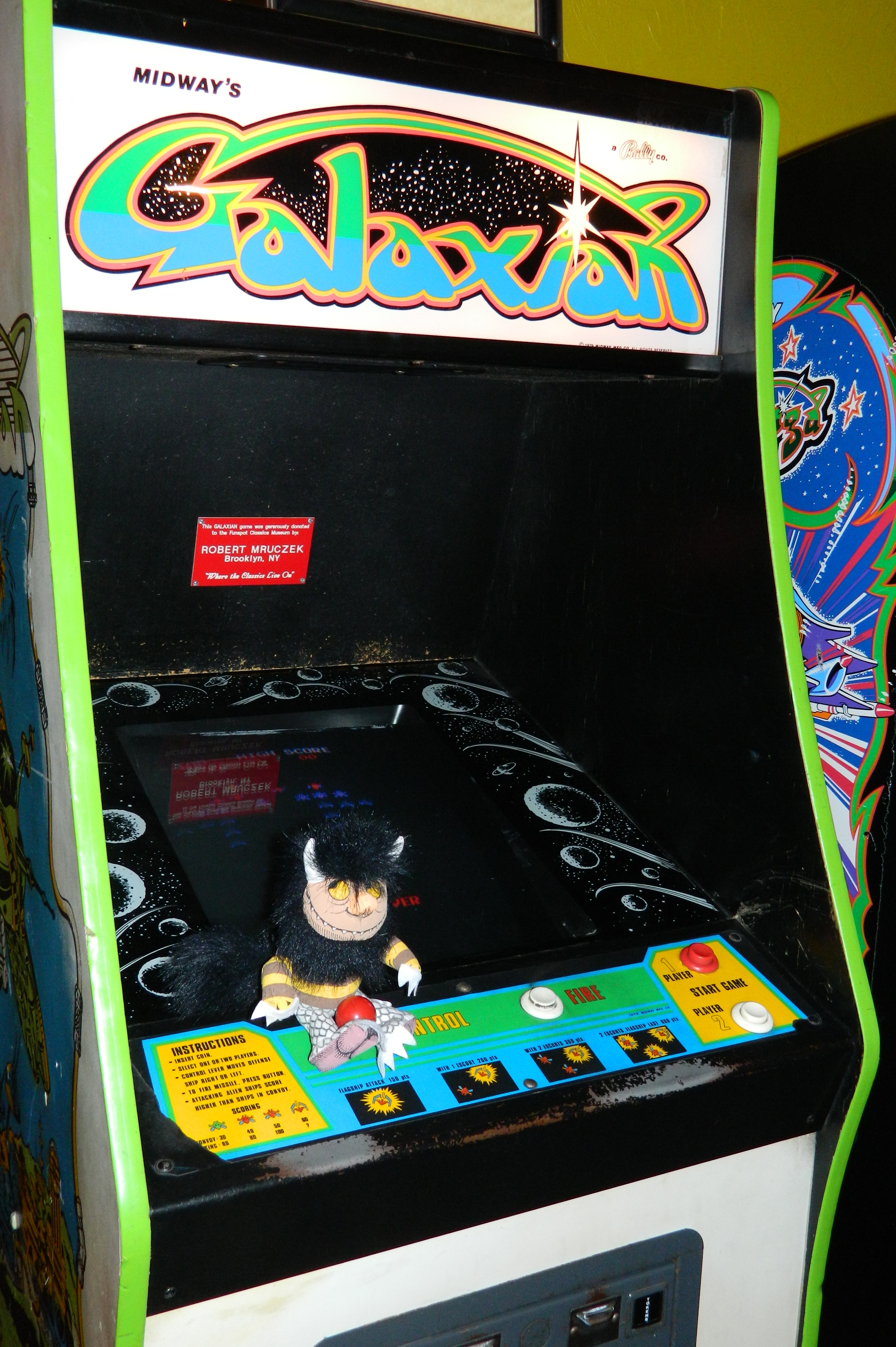
Galaxian is an arcade game developed by Namco in 1979 and released in the United States by Midway.   Galaxian was intended to capitalize on the popularity of Taito’s Space Invaders and was also a fixed, space shooter game.  It differed from Space Invaders in that it was a RGB color game and the aliens would break away from formation and ‘dive bomb’ your ship.  The RGB color screen with multi-color sprites and scrolling star background was considered ‘ground breaking’ for 1979.  The Galaxian arcade units were powered by a Z80 CPU and the game was ported to nearly every home console of the era, including the Atari 2600 and 5200, and the Colecovision.

Galaxian at Funspot

Galaxian at Funspot

Galaga…

Namco followed up Galaxian with 1981’s Galaga.  Galaga was similar to Galaxian, but added some new features such as additional alien flying patterns and ‘challenging stages’, which occur periodically during the game.  They also added the ‘tractor beam’ where your ship can be captured.  This adds a cool twist to the game as, if you have additional lives, you can kill the alien to get your ship back and it will attach to your current ship to give you double the fire power.  With more complicated alien movements, Galaga arcade units used three Z80 CPU’s and two sound generators.  Galaga was a smash hit for Namco and ported to a number of home consoles including the NES and the Atari 7800.

In 1983, Atari released Galaxian for the 2600.  The 2600 version was a pretty good port, given the hardware limitations of the VCS.  The one thing that bugs me about the 2600 port, is the crazy yellow borders; I am not sure what Atari was thinking with these.  Fortunately, more than one gamer has ‘hacked’ Galaxian to improve the appearance of the game.  Jess Ragan’s Galaxian Arcade improves both movement and graphics to be much closer to the arcade version.  Nukey and KevinMos3 have teamed up to produce an even more arcade perfect version of Galaxian for the 2600.  You can check out both of these versions at AtariAge.

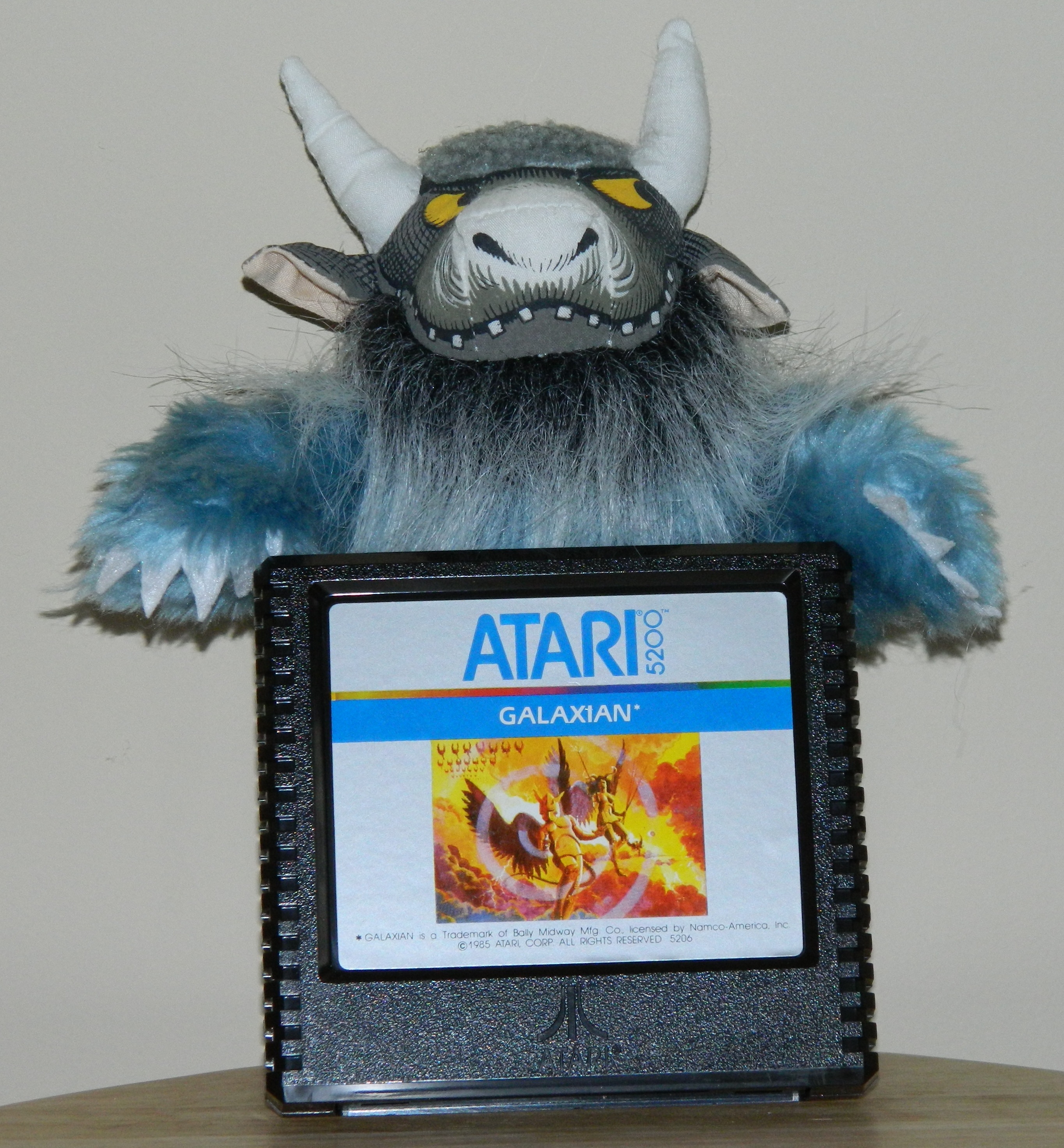
5200 owners were not left out as Atari developed a pretty good port of Galaxian as one of the release games for the 5200.  The 5200 version doesn’t have any of the cool start screens of the arcade, but the graphics and game play are well done.   Given that the 5200 has a Pokey chip for 4 channel sound, the sounds could have been programmed to be closer to the arcade, but it is still a fun game to play.  If you have a good joystick, you will not have any control issues with Galaxian, but this version also supports the 5200 Trak-ball.  I have played Galaxian with both the standard 5200 joystick and a Trak-ball and it is fun to play either way.

Galxian was not ported to the 7800, but Galaga was one of the first dozen release titles for the 7800. Like many of the early release games for the 7800, it was programmed by General Computer Corporation.  Galaga for the 7800 was positively received by many, but panned by others as not being arcade perfect.  Comparing the 7800 version to the arcade version reveals differences, but none that detract from the game play.  In fact, Galaga is one of my favorite games for the 7800 and is a pretty awesome port when you take into account that compromises had to be made as the arcade units had three CPU’s versus one for the 7800.  Galaga utilizes a single fire button, so you can play it with your CX40 or Flashback joysticks.

If you have a 2600, then you should pick a copy of Galaxian or Galaxian Arcade.   If you have a 7800, you should pick up both Galaxian and Galaga.  Also, no 5200 owner should be without a copy of Galaxian in their collection.  Since millions of copies of Galaxian and Galaga were produced, they are easy to find and are still readily available for purchase at relatively low prices!

Wild for Galaxian!

Wild for Galaxian!


Leave a comment

Scramble…

Scramble is a video game developed by Konami in 1981 and distributed in the United States by Stern.  It is a side scrolling ‘shoot ‘em up’ with outstanding graphics and game play.  In Scramble, you control an aircraft with the goal of getting as far into the Scramble system as possible.  In addition to controlling the movements of the aircraft, you must also use your guns and bombs to destroy rockets, UFO’s, and fuel tanks.  You must keep an eye on your own fuel and destroy a fuel tank to increase your fuel level.

In Scramble the terrain is constantly changing and you must fight your way through six stages:

  • Stage 1:  Launching Rockets
  • Stage 2:  UFO’s
  • Stage 3:  Meteors
  • Stage 4:  Launching Rockets from tall buildings
  • Stage 5:  Mazes
  • Stage 6:  Base

The Scramble arcade units were powered by two Z80 CPU’s and two AY-3-8910 sound generators.  It was ported to the Commodore 64, Vic 20, and Vectrex, but not to any Atari systems.  Scramble was succeeded by ‘Super Cobra’ which was ported to the Atari 2600, 5200, and 8-bit systems.

Thanks to Bob ‘PacManPlus’ DeCrescenzo, it is now possible to play Scramble on the Atari 7800.  Bob started his work on Scramble in late 2011 and completed it in March of this year.  Bob had made a few cartridges for AtariAge forum members and now Scramble is available for order from the AtariAge store.

Bob referenced the original arcade ROM’s to produce as faithful of a port as possible.  Comparing Bob’s Scramble to the arcade version, shows his typical attention to detail.  Given that the 7800 only has a single CPU and limited sound, Scramble for the 7800 is amazingly close to the arcade version.  My only comment about Scramble is that the game has some bright colors and some of them ‘saturate’ on my 7800.  I have tried Scramble on two different systems with the same result.  The color ‘saturation’ seems to only affect the lower portion of the screen and does not have any impact on game play.

In an earlier post, I discussed controllers for the 7800.  In order to control the guns and bombs, a two button controller is a must.  When I play Scramble, I prefer my modded CX24’s.  Scramble is a fun game, but it takes a lot of practice to get good at it.   Bob has built in three difficulty levels into the 7800 version which will keep you coming back for more.  Scramble is a unique side scroller for the 7800 which not only pushes the system to its limits, but, also, shows what a great home arcade system it is!  Once again, Bob has ‘knocked it out of the park’ with Scramble…another must have for your 7800!!!

Wild for Scramble!

Wild for Scramble!


Leave a comment

Taking care of your game carts…

Cleaning your carts…

I had mentioned in a previous blog that I had purchased a number of my game carts second hand.  Early 2600 and 7800 game carts had a dusk cover mechanism which protected the carts from the elements pretty well.  Later 2600 and most 7800 game carts do not have this dust cover mechanism.  Thus, many second hand carts will be pretty dusty and dirty.  Not only will this have the potential for the cart to not make good electrical contact; this dust and dirt can get down into your game system.  The simplest and most effective way to clean your carts is with isopropyl alchohol and a good quality cotton swab.  It is important to have a good quality swap so that the cotton doesn’t come off and get stuck on the cartridge contacts.  Cotton swaps are cheap, so don’t be afraid to use more than one to make sure that you have removed as much dust and dirt from your carts as possible.  Also, be sure that the cart is dry before you insert it into your game system.  The alcohol will evaporate pretty quickly, so you don’t really need to dry the cart off.  Just wait a few minutes and you should be all set.  Once you clean your carts, you are going to want to keep them clean, so see below for a storage tip!

Going Wild for Cleaning!

Wild for Cart Cleaning!

Storing your carts…

Although game carts for retro game systems are relatively cheap, if you build up a large enough collection, the total value can start to add up to some significant $$$.  After you have more than a handful of carts, you are going to want to have some way to safely store them.  I looked on-line for cart storage systems and, since it has been many years since these systems have been manufactured, asking prices are pretty crazy.  I think that I have come up with a pretty clever and simple solution.  At a local discount store, I was able to find small plastic storage bins that were the perfect size to store 24-25 carts side by side.  These bins are pretty inexpensive; in fact,  I paid less than three dollars each for my bins.  I also picked up a couple of extras of these bins to store my game controllers.  They are also great for transporting your carts, if you want to head over to a friend’s house to play some video games.  If your carts are just laying around loose, show them that you care for them and get them a new home!

Wild for Cheap Cart Storage!

Wild for Cheap Cart Storage!