Retro Game Guy

It's the 1980's again!


Leave a comment

Having a Flashback?

An Atari Flashback that is…

Atari (and AtGames) have released several ‘Flashback’ systems starting with the original in 2004.  The original Flashback looked like a micro 7800 and included a combination of twenty built in 7800 and 2600 games.  It was designed and brought to market on a short timetable and was built around an ‘NES on a chip’. Thus, all of the games ran in emulation mode.  Some hard core Atari fans did not like the Flashback, but it sold nearly a million units and convinced Atari to release the Flashback 2 in 2005.

The Flashback 2 (and 2+), like the original Flashback, was designed by Curt Vendel of Legacy Engineering.  This time around, the Flashback looked like a micro 2600 included 40 built in games.  Curt actually designed a ‘2600 on a chip’ so that the Flashback 2 was capable of running almost all 2600 games.  One of the cool things about the Flashback 2 is that Curt included solder points on the motherboard to add a cartridge slot.  Many Atari fans have done this mod to their Flashback 2 so that they can play most of their cartridge based games, as well as the 40 built in games.

In 2011 Atari allowed AtGames to build and market the Flashback 3.  The Flashback 3 includes 60 built in games and is built around an ARM processor, so all games run in emulation.  Like the Flashback 2, it uses Joysticks designed to look like the original Atari CX40.  You can also use your original Atari joysticks and paddles with this unit.

For 2012, AtGames is back with the Atari Flashback 4, due to be released in a few days.  This time around it will include 75 built in games including a new version of Space Invaders.  Some of the other classic games included in the Flashback 4 are:  Asteroids, Battlezone, Centipede, Jungle Hunt, Missile Command, and Super Breakout.  AtGames will also be selling a ‘Deluxe Edition’ that includes a set of paddles.  You will still be able to use your existing joysticks with the Flashback 4, but, for the first time, they are including wireless joysticks!

Ok, if you have a 2600 or 7800 why would you buy an Atari Flashback?  There are actually a few good reasons.  The first is that these typically sell for $40 or less and are a lot of fun.  Second, they have an AV output and work much better with today’s TV’s.  Third, the joysticks are pretty good.  They have a ‘looser’ feel than the original CX40’s, but work great.  I was able to pick up a new Flashback 3 at a local store for under $30.  At that price, it was worth it just to get the two joysticks!

If you are looking for some fun at a reasonable price, consider getting an Atari Flashback.  For more information on the Flashback 4, check out the description at AtGames!


Leave a comment

Controllers…

The 7800 is different from the 2600 in that it was supplied with joysticks with two (independent) ‘fire’ buttons.  Many 7800 games are programmed to take advantage of this second ‘fire’ button.  In the US, the 7800 was supplied with the CX24 joystick. The CX24 is not the most popular joystick, as the length of the shaft and the location of the buttons have a tendency to cause hand cramps after just a few minutes of game play.  A great guy who goes by Yurkie on the AtariAge forum will modify your CX24 controllers by shortening the shaft and adding a ball knob.  I had Yurkie do this to a set of CX24 joysticks for me and this mod makes a huge difference.  If you have a set of CX24’s and find them difficult to use, consider having Yurkie mod them for you.

The 7800 was released in Europe in 1989 and Atari supplied the CX78 gamepad with all European 7800’s.  The CX78 is similar to the NES controllers and was well received.  The CX78 is a great option if you are unhappy with the CX24’s.  Although some folks would have you believe that the CX78’s are hard to find in the US, they can be purchased new from Best Electronics at a very reasonable price.

Many 7800 games (like Ms. Pac-man, Centipede, Space Invaders, etc.) only require a single fire button.  For these games (and almost all 2600 games), a normal Atari CX40 joystick will work perfectly on your 7800.

What I have found is that I prefer different joysticks for different games.  For single fire button games, I will use my CX40.  For two fire button games that require a lot of use of the second button, I prefer my modded CX24.  For other two button games, I will use my CX78 joypad.

Finally, there are a few 7800 games (I will cover these in a future post)  that either require a light gun or can be used with one.  Atari never made a light gun specifically for the 7800, but they are not hard to find.  Atari supplied one with each XE Game System and Best sells their own Atari compatible light gun.  Remember, with a light gun, you need an old fashioned TV with a glass screen!

Wild for the CX78 Joypad!


Leave a comment

In Search of Carts…

As I mentioned in a previous blog, in order to produce new homebrew games, existing carts need to be sacrificed. In some cases, new circuit boards for carts are available and only the shell needs to be recycled. In other cases, both the shell and board are reused. The most desired cart to reuse is the 7800 cart with out a dust cover. Later 2600 (mostly red label) carts also used this same shell. They are popular for homebrews as these shells can hold either 7800 or 2600 cart circuit boards.

It is a lot of work to produce homebrew games and one of the major challenges is tracking down donor carts. There are a few of us that help out the community, by buying up old carts and providing them to game developers and the places like AtariAge. Ebay is one place that donor carts can be bought, but the prices tend to be high, except in large lots. Other options include garage sales, swap meets, and retro game stores.

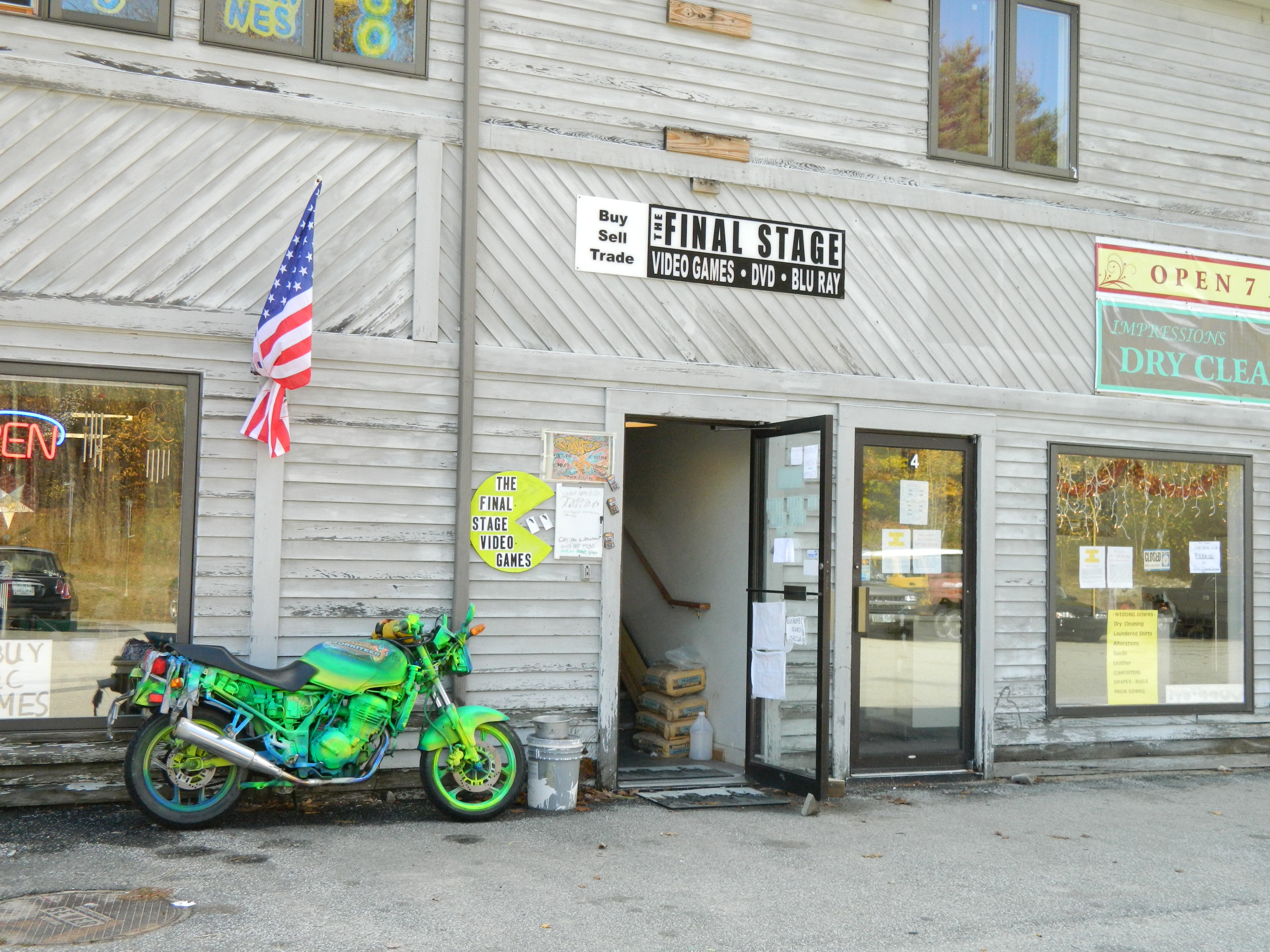
Yesterday, I visited a retro game store on Route 4 just east of Concord, New Hampshire called ‘Final Stage Video Games’. This is a small shop with all kinds of retro gaming equipment and games run by a great guy name John. Yesterday I saw all kinds of Atari, Nintendo, Sega, and Sony equipment and games. John even had a Commodore 64 in the original box! When I told John why I was there, he helped me dig through his Atari cart collection and find all of the later model 2600 carts a well as a few 7800 carts. With John’s help, I walked out of the shop with a bag full of potential donor carts

One day cart shells and 7800 boards may be manufactured again, but for now they have to be recycled. A few must die so that others may live!

Final Stage Video Games


Leave a comment

Space Invaders…

The Space Invaders arcade game was developed by Tomohiro Nishikado and released by Taito in 1978. It was a smash hit and Taito sold more than 300,000 Space Invaders arcade games in the first two years. It was so popular in Japan, that it actually created a shortage of 100 yen coins. By today’s standards, it is a pretty simple game; 55 aliens move back and forth and come ever closer to your laser cannon. The aliens also attack with laser bombs and move faster as you destroy them. The original games were a single white color and colored cellophane was used on the display to make it appear that the game was multicolored.

Back at Atari, Rick Maurer was developing a VCS (2600) version of Space Invaders. He got a prototype version of it working, but no one seemed interested. He, thus, moved on to the development of another game. In 1980, Atari was able to license Space Invaders and they had Rick complete his work on the 2600 version. It was a smash hit; the first Atari game to sell over a million copies and is credited with quadrupling sales of the 2600! The 2600 version of Space Invaders was pretty darn good; there were only 36 aliens, but it had variations that the arcade game did not. Rick added 112 variations such as 2 player modes, moving shields, zigzagging bombs, and invisible invaders. If you had a 2600, I am sure that you also had a copy of Space Invaders!

In 1982, Atari released the 5200 ‘SuperSystem’ and Space Invaders was one of the launch titles for this system.  The 5200 version of Space Invaders has a total of 48 aliens that enter from the left and march across the screen, before starting their back and forth movement.  The aliens are multi-colored and mutate their shapes in advanced rounds of the game.  Atari included a total of 12 variations as well as 1 or 2 player options.  The variations include 3 or 5 lives, slow or fast bombs, alternating slow and fast bombs, and bombs that home in on your laser cannon.  The control in this game is pretty good with a standard 5200 joystick, but the 5200 track ball gives finer control of your movements.  Atari included a nice touch by having the sound of the aliens increase as they get closer to the bottom of the screen.  The 5200 version of Space Invaders is not really a port of the arcade version, but, rather, a new concept for the game.  The concept isn’t bad, but it could have been better executed.  The graphics are not really much better than on the 2600 version and this game does not really show what the 5200 is capable of.  Space Invaders for the 5200 is still fun to play, but it could have been a whole lot better.

In 1984, Atari released the 7800 ‘ProSystem’  and officially cancelled the 5200.  Atari developed 7800 specific ports of many arcade classics, but not Space Invaders. Fortunately, Bob DeCrescenzo has done an excellent port of Space Invaders for the 7800. Bob’s game is true to the arcade with all 55 aliens and adds similar options to Rick’s 2600 version such as such as 2 player modes, moving shields, zigzagging bombs, and invisible invaders. Bob also added color options to reflect the different cellophane overlays that were used on the arcade systems. Bob’s version is challenging, addictive, and a ‘must have’ for anyone who has a 7800! Space Invaders for the 7800 is available from AtariAge.

7800 Space Invaders

7800 Space Invaders

If you are lucky enough to have played Space Invaders on all three Atari systems, then I am sure that you will agree with me the Bob’s 7800 version is the clear winner.  If you don’t have a copy Space Invaders for the 7800, rush over to AtariAge and order yourself a copy of this great game!

Wild for Space Invaders!


1 Comment

Still Shrink Wrapped?

The 7800 was released in 1986…over 25 years ago! Atari released about fifty games for the 7800 and there were also several 3rd party releases.  One of the things that has amazed me is that it is still possible to buy brand new games for the 7800.  Atari sold about four million 7800 systems and they must have also made millions of games.  Many of these can be had, inexpensively, still shrink wrapped, as they just came from the factory.  In fact, I paid no more than $15 each for my first few games, but some were as inexpensive as $5.  I was also able to pick up some used games on ebay.  I have learned to buy games in lots of six or more; large lots often go for as little as $1-2 per cartridge.  Of course, at that price, you are just getting cart without the box or manual.

Games like Alien Brigade, Commando, Ikari Warriors, and Midnight Mutants were released toward the end of the 7800’s life cycle and were manufactured in smaller quantities.  These command higher prices all the way up to $100 for a shrink wrapped copy.  While collectors may want to have complete games with boxes and manuals, all you need to have fun is the cart itself.  There are several sites where you can find the manuals for the games, so it is easy to build up a good collection of 7800 games without spending a lot of $$$.

Also, don’t forget that the 7800 plays almost all of the 2600 games. Loose 2600 carts often sell for less than $1 and there were some great games made for the 2600!  Games like Demon Attack, Missile Command, Pitfall, and Warlords play great on the 7800 and are as much fun now as they were 30 years ago!


Leave a comment

The Box Arrives…

A few days after I ordered my 7800, I received a notice from my post office that a package had arrived for me.  I managed to get there just before they closed and picked up my 7800. I had ordered one with an AV mod.  Originally, these came with RF modulators that you could set to either channel 3 or 4.  A better solution for today’s TV’s is to have the system modified to do either S-video or composite output; mine was modified for composite output.  Even with an AV mod, these are not the greatest with modern HD TV’s as they have many less lines of resolution.  Fortunately, I still had a non HD LCD TV to use with my 7800.

With my 7800, was the four or five games that I had ordered with it.  After hooking up the 7800 to my TV, I put in Donkey Kong and was amazed.  Sound is a weak point on the 7800 (I will explain why in the future), but the graphics are amazing (for a machine designed in the mid eighties).  In fact, one of the strong points of the 7800 is that it was designed to bring the arcade experience home.  There are some amazing ports of arcade classics such as Centipede, Donkey Kong, Galaga, Joust, and Ms. Pac-man.  The experience was all that I hoped for…all you need to do is put a cartridge in and start playing.  Even for the games where you need the manual, they usually only take a few minutes to read.  The 7800 definitely looked like it was a good choice and more great games were still in the mail!