Retro Game Guy

It's the 1980's again!


Leave a comment

Q*bert…

Q*bert is a 1982 video game developed by Gottlieb.  Warren Davis and Jeff Lee co-developed Q*bert and gave him a long nose so that he could shoot projectiles.  Fortunately, the shooting aspect of the game was dropped and Q*bert became the lovable character that we all know.  In fact, Q*bert was the third most merchandised game, after Donkey Kong and Pac-man.  Q*bert was a major hit for Gottlieb with more than 25,000 arcade units sold.  It was offered as both an upright cabinet and a cocktail table.  The cocktail table units are fairly rare as only a few hundred were manufactured.  The Q*bert arcade units were powered by an Intel 8086 cpu and had mono sound and used a standard 19” CRT.  Q*bert was ported to a number of home consoles of the era including the Atari 2600, & 5200, the Colecovision, the Intellivision, and the NES.

Gameplay…

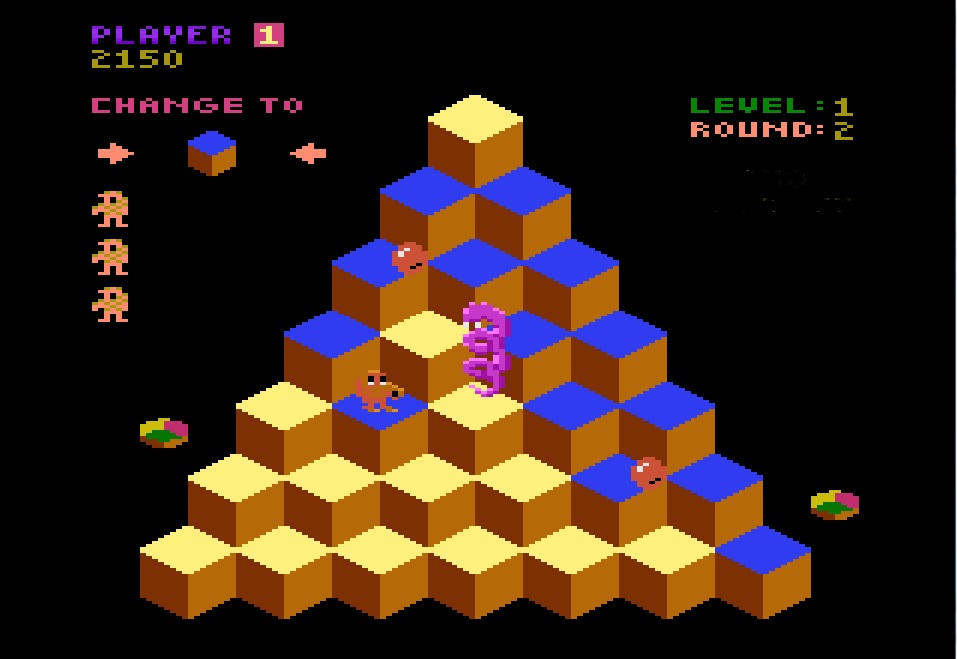
Q*bert is an isometric 2D platform game that fools you into thinking that it is 3D.  Q*bert must jump diagonally from cube to cube and change the colors to the target color.  In advanced stages, Q*bert must change the cube colors multiple times to reach the target color.  Q*bert has to deal with several antagonists including:

  • Coily the snake:  The purple snake that hatches and chases Q*bert
  • Ugg and wrong way:  the purple guys that move along the side of the cubes
  • Sam: the green guy that changes the cube colors back
  • -Red balls will appear at the top of the pyramid and bounce down and off the cubes

Q*bert must avoid any of the red or purple advisories to keep from losing a life.  To avoid Coily, Q*bert can jump onto one of the color disks besides the pyramid of cubes and be whisked away to the top.  If Coily is close enough, he will follow and jump off the cubes.  Occasionally, a green ball will appear.  If Q*bert contacts this ball, time will stand still, allowing Q*bert to change cube colors unimpeded.  When all of the cube colors have been changed to the target color, Q*bert advances to the next level.  If Q*bert loses a life, he will say something like…@#?&!

2600 Version…

The 2600 version of Q*bert was released by Parker Brothers 1983.  Later on Atari released Q*bert under their own label, so you may run across this version.  Both versions are exactly the same.  The 2600 incarnation of Q*bert is typically highly rated and definitely plays like that arcade.  As with most 2600 games of the era, the graphics are dramatically simplified with all of the sprites being mono-colored.  There is no intro screen and, sometimes, it is hard to tell what level you are at.  Control with the standard CX40 joystick is good and Q*bert is fun to play.  With today’s technology such as the Melody board, I am wondering if someone will take advantage of 32K of memory and the ARM cpu to develop an updated 2600 version of Q*bert.  This game just screams for an update…any 2600 homebrew developers listening?

5200 Version…

The 5200 version of Q*bert was also released by Parker Brothers in 1983 and, compared to the graphics of the 2600, it looks much better.  The 5200 is capable of some pretty good graphics, so I wonder if the developers at Parker Brothers just settled for ‘good enough’?  The game has mono-color sprites and no intro screens, but the cubes look pretty good .  It also suffers from the 5200’s analog, non-self-centering joystick.  The game designers tried to compensate by having you hold down the fire button in addition to moving the joystick in the direction that you want to move Q*bert.   Even using a refurbished 2nd generation gold Best Electronics joystick, it was hard to control the movements and I found my Q*bert periodically committing suicide by jumping off the pyramid.  If the 5200 is your only system, I am sure that you will adapt as the control isn’t impossible, just more challenging than in the 2600 version.  All in all, Q*bert  is easy to come by, inexpensive, and worth having in your 5200 collection.

7800 Version…

Parker Brothers never developed a 7800 version of Q*bert, so for years 7800 owners had to make do with the 2600 version.  In 2007, Ken Sliders came to the rescue with his version which he has called b*nQ.  B*nQ is looks and plays like the arcade version and includes intro screens and to help the player know which level they are on and what the target color is.  Since only one button is required for this game, you can use a standard CX40 joystick.  The 7800 version doesn’t suffer any of the control problems of the 5200 version and is a blast to play!  There is absolutely nothing bad to say about b*nQ for the 7800…Ken has made this game almost arcade perfect!  If you have a 7800, you need to go straight to the AtariAge store and order yourself a copy of this great game!!!

Overall thoughts…

Before doing the research for this post, I hadn’t really played Q*bert very much.  I had purchased b*nQ about a year ago, but had played some of my other classic games more often and b*nQ was just taking up space in my collection.  In the past couple of weeks, as I prepared for this post, I have almost become addicted to this game.  No matter which Atari system you have, you should definitely have a copy of Q*bert in your collection.  If you have multiple systems, Ken’s b*nQ is amazing and blows the others out of the water!
b*nQ for the 7800

b*nQ for the 7800

@Atarigameguy


1 Comment

Joust…

Joust is a 1982 video game developed by Williams Electronics.  John Newcomer was the primary developer of Joust and his goal was to develop a two player arcade flying game totally different than the multitude of space themed games of the era.   Joust was definitely a unique concept for the time and was a good seller for Williams with more than 26,000 arcade units sold.  It was offered as both an upright cabinet and a cocktail table.  The cocktail table units were unique in that both players sat on the same side.  This allowed Williams to use the same ROM in both types of arcade units.  The cocktail units are pretty rare as only a few hundred were manufactured.

Gameplay…

In Joust, you must ride your ostrich and compete against enemy knights riding buzzards.  You can ‘kill’ an enemy knight in a joust by ramming him by being at a slightly higher flying level.  When you kill an enemy knight, he will turn into an egg that you must then capture before it hatches.  If the egg hatches, the knight will become the next more-challenging nemesis (a Bounder will become a Hunter, a Hunter will become a Shadow Lord and so on). After the egg hatches, a buzzard will fly out to pick up the new enemy knight.

In the first two waves, the platforms at the bottom of the screen allow you to walk over the lava pits, but in later waves, the platforms will be burned away.  Also, in later waves, flames will start to burn in the lava pits.  Sometimes, a pterodactyl will show up, in later waves, and try to fiercely charge at you.  The only way you can ‘kill’ the pterodactyl is to ram him in the mouth to disintegrate him.

If you fly too close to either of the lava pits, a lava troll can reach out and grab your mount by the legs and pull you both into the lava. If this happens, you must have your mount repeatedly flap really hard to escape.  Also, in later waves, the platforms will collapse and disintegrate. Occasionally, there will be an egg wave where you must collect all the enemy eggs before they hatch.

2600 Version…

Released in 1983, the 2600 version of Joust has dramatically simplified graphics, mono-color sprites, and no fire pits.  Additionally, the eggs will bounce around, rather than remaining stationary.   As far as the game play goes, the 2600 version is one of the better arcade ports of the era.  Control with the standard CX40 joystick is good and it is fun to play.  With today’s technology such as the Melody board, I am wondering if someone will take advantage of 32K of memory and the ARM cpu to develop an updated 2600 version of Joust.  Even if this doesn’t happen, Joust for the 2600 is a solid port and worth having in your collection.

5200 Version…

The 5200 version of Joust was also released in 1983 and, compared to the graphics of the 2600, it really looks awesome!  With the exception of the simplified, mostly mono-color sprites, it is, graphically, almost a perfect arcade port.  The 5200 version looks and sounds great and belongs in every 5200 collection.  I will say that the game play does suffer from the 5200’s analog joystick.  Even using a refurbished 2nd generation gold Best Electronics joystick, it was hard to control the movements of my ostrich.  If the 5200 is your only system, I am sure that you will adapt as the control isn’t impossible, just more challenging than in the 2600 version.  All in all, Joust is easy to come by and inexpensive and belongs in every 5200 collection.  BTW, there is an almost identical version available for the Atari 8-bit computer line.

7800 Version…

The 7800 version of Joust was developed for the 1984 release of the console.  As one of the early releases, millions of copies were manufactured and it is still possible to find sealed copies for less than $10.  If you have a 7800, this game positively  belongs in your collection.  It is even closer to the arcade version than the 5200 version and the control is much better with a digital joystick.  In fact, since only one button is required for this game, I prefer to use a standard CX40 joystick.  There is absolutely nothing bad to say about Joust for the 7800…Joust, in fact, demonstrates that the 7800 was definitely a most capable home arcade system!

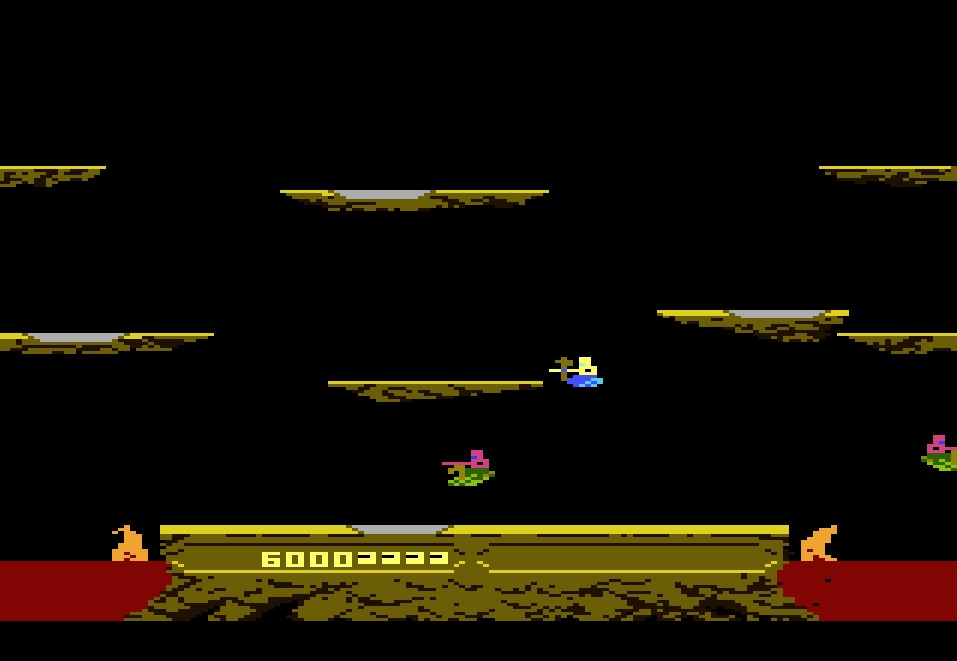
Joust for the 7800

Joust for the 7800

Overall thoughts…

Before doing the research for this post, I really didn’t know that much about Joust.  Obviously, I was aware of the game, but can’t remember playing it in the arcade and I didn’t have a copy of the 2600 version back in the 80’s.  All I can say is that I really missed out on a classic game that definitely differentiated itself from all of the space shooters of the early 80’s.  No matter which Atari system you have, you should definitely have a copy of Joust in your collection.  If you have multiple systems, the 7800 version is the hands down winner!

@Atarigameguy


Leave a comment

Dig Dug…

Dig Dug is a 1982 arcade game released by Namco and distributed by Atari outside of Japan.  The goal in Dig Dug is to score as many points as possible by digging and ‘killing’ the two types of antagonists…Pookas and Fygars.  There are two ways to ‘kill’ Pookas and Fygars…by dropping rocks on them or by inflating them until they ‘pop’.  The farther down that you dig and ‘kill’ your enemies, the more points you will score.  Additionally, double points are awarded, if Fygars are pop’d horizontally.  Finally, if a player drops two rocks in  a round, bonus items, such as fruits, will appear on the screen and additional points are awarded for ‘eating’ these items.

Dig Dug was designed to run on Namco’s Galaga arcade board (3x Z80 CPU’s) and was extremely popular.  Many people consider Dig Dug one of the best arcade games of the era.  The game, with it’s simple concept and graphics was a natural to port to home systems.  It was ported to the Atari 2600, 5200, 7800, Intellivision, and just about every other 8-bit home console/computer.  The one exception was the Colecovision…a Dig Dug port was developed by Atarisoft, but never officially released.

2600 Version…

The Atari 2600 version of Dig Dug was released in 1983 and, although the graphics were simplified, the game play is intact and solid.  Dig Dug, Pooka, and Fygars have simplified mono-color sprites and the background graphics and rocks are not pretty to look at, but the 2600 version is fun to play and it has a cool start screen!  With the capabilities of the Melody board and the talent of some of today’s homebrew programmers, I wonder how long it will be before someone makes an enhanced Dig Dug for the 2600?

5200 Version…

The 5200 version of Dig Dug was also released in 1983 and features improved graphics and sound over it’s 2600 counterpart.  Dig Dug, Pooka, and Fygar are still rendered in mono-color graphics, but the background and rocks are much closer to the arcade version.  Control with the standard 5200 analog joystick is solid and the game play is very close to the arcade.  Although it should have been possible to have multi-color sprites which would have improved the appearance of the game, Dig Dug for the 5200 is solid and a great addition to every 5200 collection!

7800 Version…

Dig Dug for the 7800 was one of the release titles for the system and is the ‘premier’ version for 8-bit Atari consoles.  The sprites for all of the characters are rendered in multi-color, there is a cool start screen, and the sound (usually a short coming for the 7800) is well done.  The NES version may have slightly sharper graphics, but the 7800 version is that hands down winner for Atari console versions.  All of the arcade elements and scoring are present and it is a blast to play.  If you have a 7800, this game is a must have for your collection!

Dig Dug for the 7800

Dig Dug for the 7800

Overall thoughts…

Back in the eighties, I played Dig Dug a few times, but had never really learned much about the game.  In doing the research for this post, I have learned how the scoring works, the strategy for playing Dig Dug, and why so many people have such fond memories of this great game.  100’s of Thousands (if not millions) of Dig Dug cartridges were made for all three Atari 8-bit consoles, so they are easy to find and inexpensive.  No matter which Atari console you have, Dig Dug belongs in your collection!

@Atarigameguy


1 Comment

Emulation?

I really enjoy owning my classic game consoles and collecting games.  I enjoy the simplicity of putting a cartridge in a console and only having to master the control of a joystick with one or two buttons.  Why, then, consider emulating these classic systems?

First of all, emulation has made the Atari Flashback series possible.  The first Flashback was based on a ‘NES on a chip’ and all 20 games ran in emulation.  In the latest Flashback 4, the emulation has improved to the point where it is so good that the games play almost as they do on an original 2600.  Emulation has helped make it cost effective to provide 75 games (with wireless controllers) for as little as $30-40.

I was one of the lucky people to be able to get an HP TouchPad when HP sold them at fire sale prices.  I am among a smaller group of people that still use their webOS devices on a daily basis.  Believe it or not, there is a 2600 emulator for webOS!   Emulators also exist to allow you to play classics like Asteroids or Space Invaders on your Android or IOS smart phones and tablets.  This is great if you are travelling and want to bring some of your favorite games along.

The main reason that I wanted to set up an emulator on one of my PC’s was to help test new homebrews for the 7800.  The 7800 was one of the later systems to have an emulator developed for and there are a couple of different choices.  I chose ProSystem to install on a Windows 7 laptop.  Not wanting to have to use the keyboard to play games, I also picked up a USB joystick made by Curt Vendel of Syzygy.  Curt has designed these joysticks to look and feel just like an original Atari CX40.  I was surprised at how good the emulation is on ProSystem and how much fun it is to play Atari games on a PC, when you have a joystick.  With guys like Bob, Ken, Mark, and Perry still developing and enhancing games for the 7800, I am now looking forward to being able to test and provide feedback on their latest creations.

Whatever your system of choice is, there is probably an emulator that has been developed for it.  If you are an Atari fan, consider setting up Stella or ProSystem on your PC and getting one of Curt’s awesome USB joysticks.  You too can help improve homebrews by testing and providing feedback!

@Atarigameguy

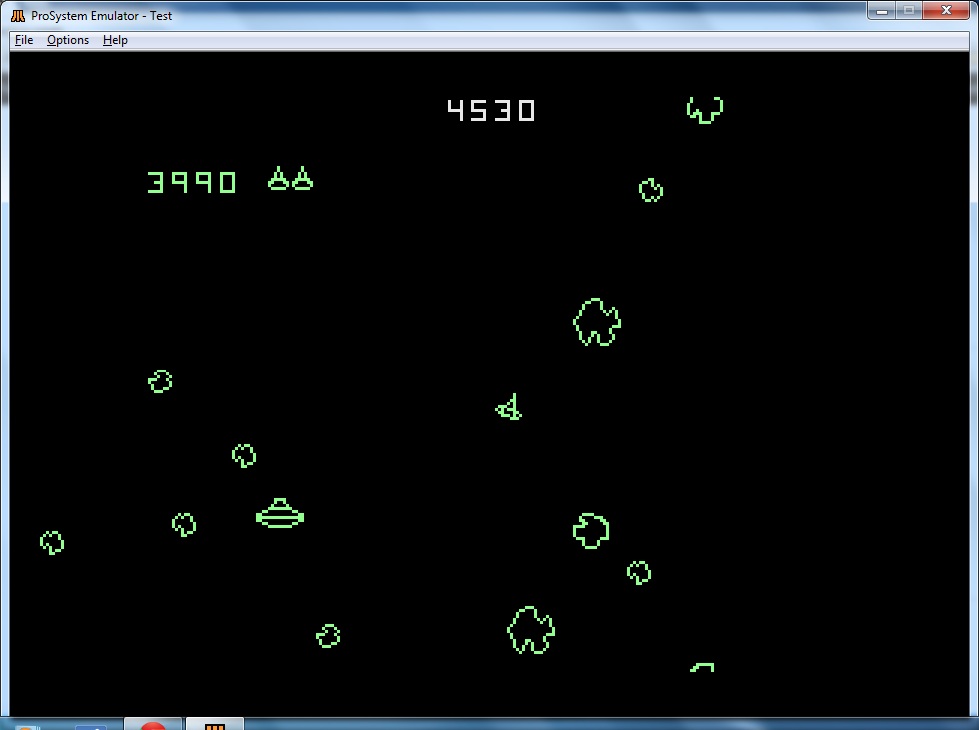
Asteroids Deluxe on ProSystem

Asteroids Deluxe on ProSystem


Leave a comment

Video Games Then & Now…

Last week I was in the Chicago area for business and managed just enough time for  quick stop at a great Video Retro Game shop…Video Games Then & Now.  Just a short drive from O’Hare, Video Games Then & Now is at 4351 North Harlem Drive in Norridge, IL.  The shop is staff by friendly folks and has an amazing collection of systems, controllers, parts, and games for everything from the Atari 2600 to the X-Box.  In fact I saw games for the Atari 2600, 5200, & 7800 systems as well as Intellivison, Colecovision, Sega Genesis, Vectrex, and many more.

The prices are really fair (I picked up a number of 5200 and 7800 carts for as little as $1 each) and they will buy your old games or take them in trade.   I also picked up a brand new (still boxed) controller for my 7800 as well as a boxed 7800 game.

The store hours are:

  • Monday-Saturday 11am-9pm
  • Sunday 12pm-6pm

If you happen to be in the Chicago area, then you owe it to yourself to stop in and check out this great shop!

@Atarigameguy


1 Comment

Pole Position…

Pole Position is a 1982 racing video game developed by Namco.  It was licensed to Atari for release in the US and became a smash hit.  It was the most popular coin op game in 1983 and Atari sold more than 20,000 Pole Position arcade units.  Pole Position came in both an upright cabinet and a ‘cockpit’ cabinet where the player could sit inside.

In the game, the player controls a Formula One race car on the Fuji racetrack.  First you must qualify your car, then race against computer opponents.  One of the iconic moments in the game is at the start when you hear ‘Prepare to Qualify’.   Pole Position was one of the first video games to have product placement.  Billboards in the game feature company logos including Agip, Cannon, Champion, Marlboro, Martini, Namco, and Pepsi .  These logos varied by country and included Atari, 7-Eleven and Dentyne in the US.  The arcade units were powered by a Z80 CPU and Namco sound units.  Pole Position was ported to a number of home consoles including the Atari 2600, 5200, and 7800, the Intellivison, and the Vectrex.

Atari 2600…

The 2600 version of Pole Position was released by Atari in 1983.  Play is close to the arcade and control with a standard Atari joystick is solid.  Most reviewers give Pole Position high marks, but I am not impressed with the 2600 version.  The graphics are horrible and don’t look anything like the Fuji race track.   The computer generated opponent cars are ‘blocky’ and you have to use a lot of imagination to see them as Formula One race cars.  Also there are no billboards and the crash graphics are pretty lame.  Even for a 1983 2600 game, Atari should have been able to do a better job with the graphics.

Atari 5200…

The 5200 version of Pole Position was also released by Atari in 1983 and, compared to the 2600 version, it must have seemed pretty amazing.  The graphics are dramatically improved and the track definitely looks like Fuji.  The cars are less ‘blocky’ and control with a standard 5200 analog joystick is solid.  The game play is very close to the arcade and it is challenging to weave your way around all of the computer generated opponents.  Surprisingly, the ‘Prepare to Qualify’ announcement at the start of the game is missing.  Given the awesome voice synthesis in Berzerk, we know it is possible to do this on the 5200.  As good as Pole Position is on the 5200, it could be even better.  The billboards are present, but they are all blank and it should be possible to make the cars less ‘blocky’.  All in all Pole Position on the 5200 is a must have for any 5200 collector.  It was the initial ‘pack in’ game for the 5200 and is inexpensive and vey easy to find.

Atari 7800…

The 7800 version of Pole Position was developed in 1984 and released with the system in 1986.  Actually, the 7800 version is Pole Position II which is even better!  It features the option to select one of four tracks to race and dramatically improved graphics over the 5200 version.  Both the player’s and the computer generated opponent cars actually look like Formula One race cars and billboards are present (even if they all have Atari logos on them!).   One thing that really stands out in the 7800 version is the crash graphics.  The ‘explosion’ actually looks pretty good and it is cool to see the tires bouncing away from the car.  The sound effects are also pretty good, considering that this is one of the weak points of the 7800.  Unfortunately, however, the ‘Prepare to Qualify’ announcement is still missing.  Pole Position was the ‘pack in’ game for the system and was also sold separately.  It is easy to find and inexpensive, often selling for as little as $1.  A copy of Pole Position II belongs in every 7800 collection.

Recommendations…

If you only have one Atari console, then, by all means, pick up Pole Position for which ever system you have.  If you have more than one Atari console, then the 7800 version, with better sound and graphics and four tracks to play, is the clear winner!

@Atarigameguy

Wild for Pole Position!

Wild for Pole Position!


Leave a comment

Retro Game Happenings…

Recent happenings in the retro game community…

PacManPlus…

Back on Thanksgiving, I posted about Bob ‘PacManPlus’ DeCrescenzo retiring from game development.  After about three months away from retro game development, Bob has returned to the Atari scene.  Recently, he has completed a new game which he has named Armor Attack II.  This game is based on the 1980 Cinematronics arcade game Armor Attack.  Bob has developed this game for the Atari 7800 console and it will be released by AtariAge in the near future.  You can read more about this great game here.  Welcome back Bob!!!

Tempest…

One of the most anticipated and exciting recent game release is Tempest for the Atari 5200.  I wrote an extensive post about Tempest back on March 2nd.  Read my post here, but, if you have an Atari 5200, you need to get this game!

Space Rocks…

Back in November of 2012, I posted about Asteroids and a new Atari 2600 version of Asteroids Deluxe by Darrell Spice.  Darrell called his version Space Rocks and AtariAge had a label contest for this new game.  Darrell finished the game, AtariAge has had the manuals printed, and is in the process of producing the initial run of carts.  You can read more about this great game here.  Look for Space Rocks in the AtariAge store soon!

Atari Inc. : Business is Fun…

Late last year Curt Vendel and Marty Goldberg completed their book about Atari that was almost eight years in the making.  Nearly 800 pages long and filled with rare photos, memos, and court documents, the book tells the story of Atari.  The book is available from Amazon and some outstanding reviews about the book are posted here.

Twitter…

I decided to open a Twitter account to help me follow developments in the retro game world.  You can follow me…

@Atarigameguy


Leave a comment

Warlords…

Warlords is a 1980 arcade game developed by Atari.   Atari released the game in both an upright cabinet and a cocktail table version.  The upright version featured a 23” black and white monitor that was reflected in a mirror onto a castle wall background to give a 3D effect.  Color overlays were used to give each castle a different color.  The cocktail table version featured a 14” color monitor.

The concept of Warlords is to ‘attack’ the other players by deflecting the fireballs to break through their castle walls and kill their king.  At the same time, you must protect your own castle.  You can either deflect an incoming fireball or catch it and aim it at another player.  As you hold the fireball, however, sparks will attack and slowly destroy your own castle.  When another player’s king is destroyed, an additional fireball is launched.  The upright cabinet version allowed for 1 or 2 players against the computer, but the table version allowed for as many as 4 players to play simultaneously.

Warlords was only a moderate success for Atari with a little over a thousand of each arcade type sold.

2600 Version…

In 1981 Atari released a port of Warlords for the 2600.  The 2600 version was programmed by Carla Meninsky.  Carla was one of only two women programmers at Atari and had previously programmed the award winning Dodge ‘em.  Compromises were made with the graphics, but the game play survived the conversion to the 2600 intact.  On the 2600, Warlords was played with paddles and as many as 4 players could play simultaneously.  Warlords was one of the top selling games for the 2600 and became the ‘ultimate party game’ back in the early eighties.  I can remember playing Warlords with my friends over and over !

In 2006 Darrell Spice set about to develop a better version of Warlords for the 2600.  With a little help from some friends, he developed Medieval Mayhem with improved graphics, AI, and sound.  Taking advantage of a 32K cart and bank switching, Darrell was able to develop a 2600 game that was much closer to the arcade version than Carla’s 1981 port.  Darrell’s version includes an on screen menu with a number of options including fireball speed, catch, and multiple fireballs.  The graphics are dramatically improved and include the dragon that starts the game by launching the fireball.  You can read more about the development of Medieval Mayhem here.

5200 Version…

Atari never developed a version of Warlords for the 5200, but, in 2004, Bryan Edewaard developed a version which he called ‘Castle Crisis’.  Since the Arcade units, used the same 6502 CPU and Pokey chip for sound as the 5200, Bryan was able to make Castle Crisis look and sound almost arcade perfect.  In fact, it was so close to the arcade that Atari was not originally happy with Castle Crisis being released.  Castle Crisis supports up to 4 simultaneous players, but, of course, you need to have a 4 port 5200 to take advantage of this.  You use the standard 5200 joysticks to play Castle Crisis and I found the control to be satisfactory, but not as easy as with paddle controllers on my 7800.  Some 5200 enthusiasts have developed their own paddle controllers to play this great game.

7800 Version…

Sadly, no 7800 version of Warlords has been developed.  Fortunately both the 2600 versions of Warlords and Medieval Mayhem play perfectly on the 7800.

Recommendations…

It is always hard to decide which version is the best and this time it is particularly difficult as all of these versions are awesome.  Although Castle Crisis is almost arcade perfect, I am going to give a slight edge to Medieval Mayhem as it is just more fun to play this game with paddle controllers.

As a side note, Bryan has also developed an Atari 8-bit version of Castle Crisis and you play that one with paddles!

So…if you have a 2600, 5200, 7800, or Atari 8-bit system, make sure that you get yourself a copy of either Medieval Mayhem or Castle Crisis!  Both of these great games are available from AtariAge.


1 Comment

Centipede…

Centipede is a 1980 video game developed by Atari.  It is notable in that it was one of the few video games that was co-developed by a woman (Dona Bailey) and, also had a large female following.  Centipede was a monster hit for Atari and it could be found in nearly every arcade in the early 80’s.  Centipede is based on the standard Atari hardware of the era with a single 6502 CPU, a single Pokey chip,  and a 16 color CRT.

The concept of the game is pretty straight forward.  The centipede starts at the top of the screen and moves down a level every time it encounters a mushroom.  You must use your wand (blaster) to shoot the centipede before it gets to you.   If you hit the centipede in a center section, it will split in two.  You must also defend yourself from spiders that enter from the sides and fleas that fall from the top.  Scorpions periodically run across the screen and ‘poison’ any mushrooms that they contact.  If the centipede contacts a poison mushroom, it will ‘fall’ to the bottom of the screen.

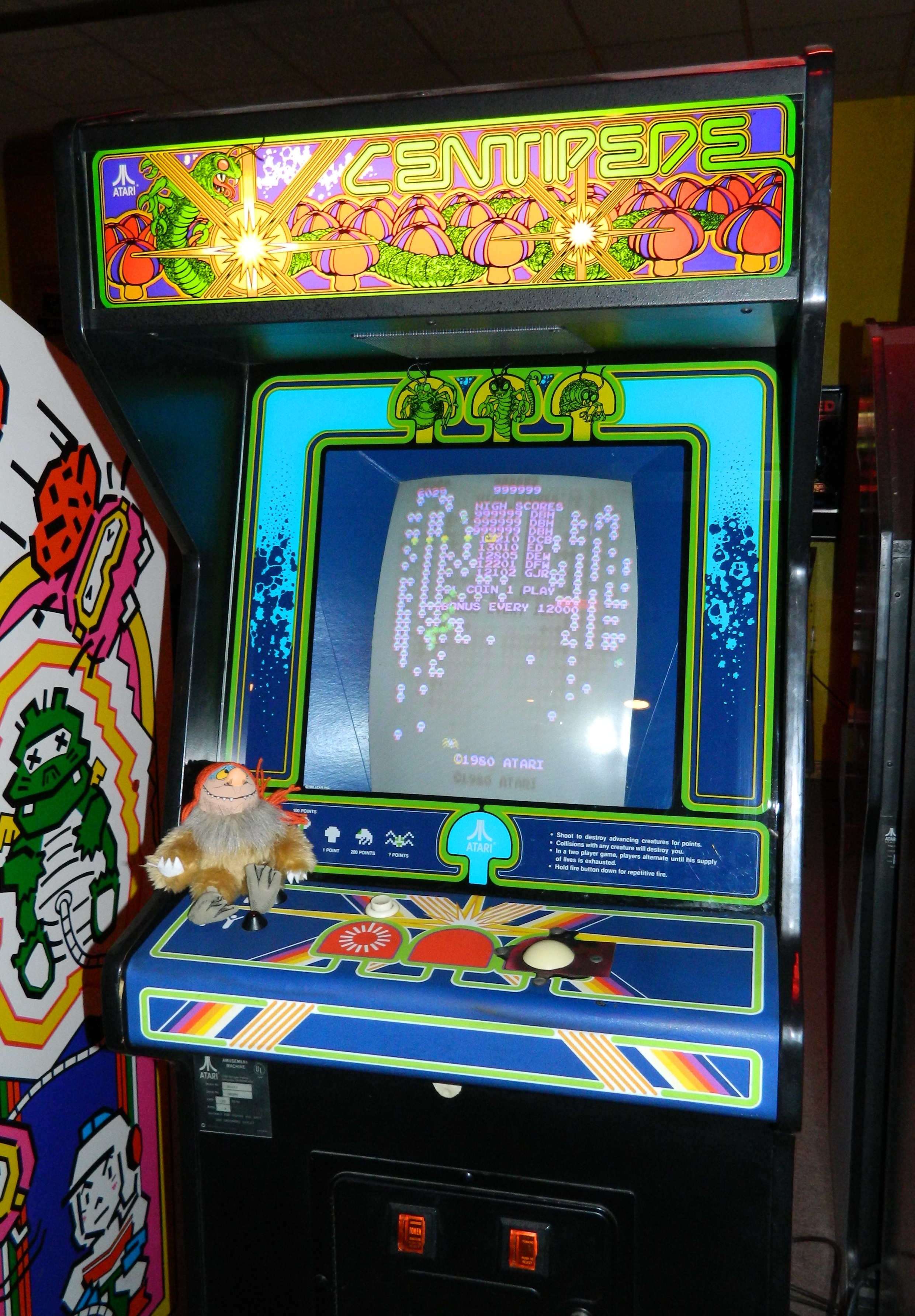
Centipede at Funspot

Centipede at Funspot

Centipede was ported to a number of home consoles and computers including the Apple II, the Commodore 64, and the Atari 800 and the Atari 2600, 5200, and 7800 consoles.  In fact, it is one of the few games to be ported to all 4 of Atari’s 8-bit game systems.

In 1982, Atari released Centipede for the VCS/2600 and, when you power up your 2600 with a Centipede cartridge installed, you will be amazed with the start screen…you will think that you are about to see an amazing graphical port for the 2600.  Unfortunately, the start screen is as far as the amazing graphics go.  The game graphics are disappointing as the mushrooms have become simple square blocks.   As far as the game play goes, however, the 2600 version has it all…mushrooms, spiders, fleas, and scorpions.  It plays as close to the arcade version as any 2600 port.  In fact, Centipede is one of the top games for the 2600!

When the 5200 SuperSystem was introduced in 1982, Centipede was one of the early releases.  Given that a Centipede arcade unit has the same basic CPU and sound chips as a 5200, it should be no surprise that the 5200 version is a classic port.  Like the 2600 version, all of the arcade elements are present, but this time the graphics and sound are spot on.  Control with a standard 5200 joystick is solid, but the 5200 version supports the use of the Trak-ball unit.  Centipede is one of the top games available for the 5200.

In 1987, Atari released Centipede for the 7800 ProSystem.  Even though the 7800 lacks the sound capability of the 4 channel Pokey chip, Centipede is well executed with a nice start screen, great graphics, and more than adequate sound.   The only thing negative to say about the 7800 graphics is the box that is drawn around the screen.   The 7800 version makes up for any shortcomings with neat two player modes.  Two players can alternate turns, play against each other (at the same time), or play together as a team.

It is hard to say which version of Centipede is the best port.  The two player modes in the 7800 version make it a blast to play with a friend, but I give a slight edge to the 5200 version for its accuracy to the arcade version.  No matter which Atari home console you have, a copy of Centipede belongs in your game collection!

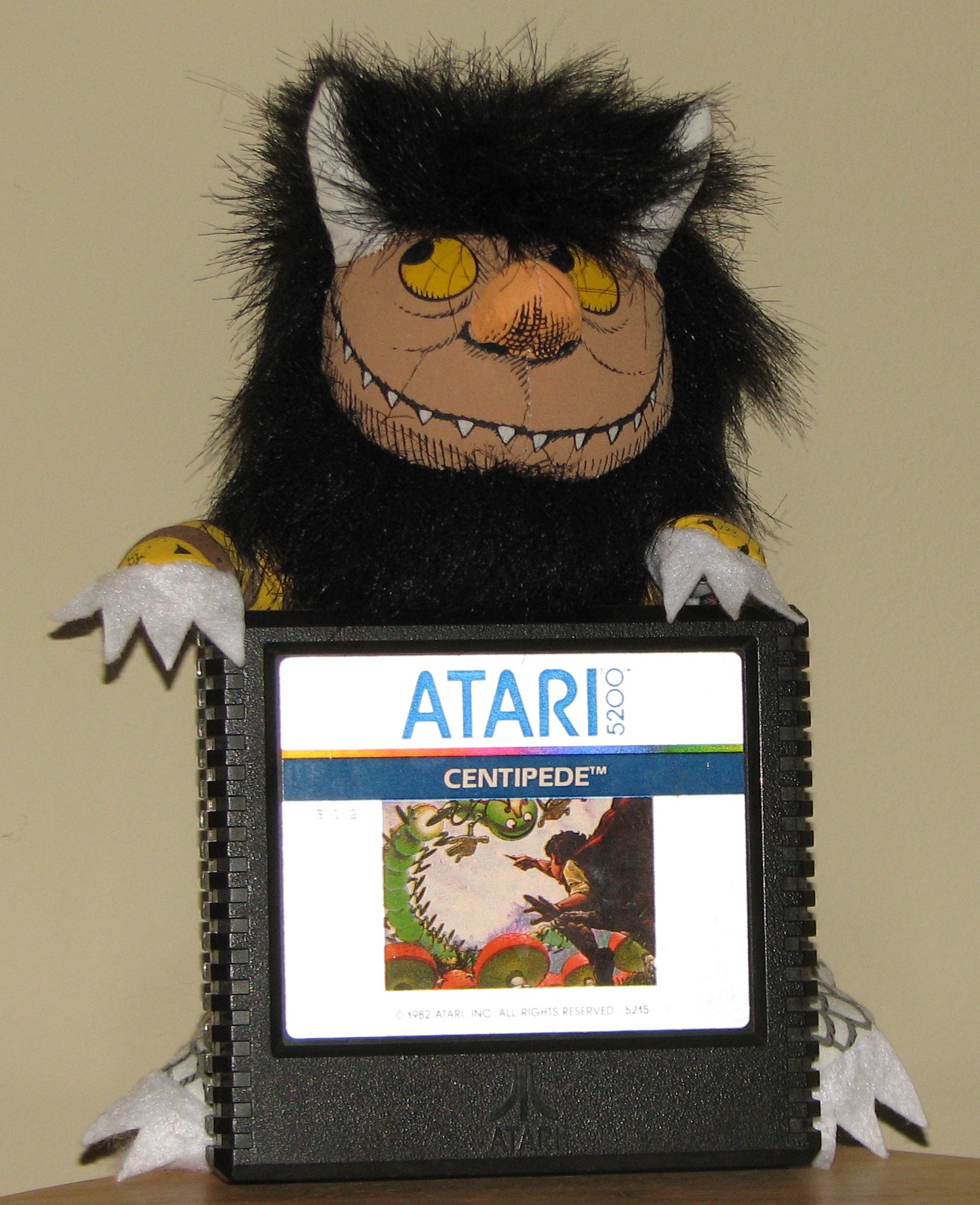
Wild for Centipede!

Wild for Centipede!


Leave a comment

8-Bit Atari Game Systems…

Since 1977, Atari has released a total of five 8-Bit game systems.  In this post, I will provide a description and a little information about each one…

Atari 2600 (VCS):

Released in the fall of 1977, the Atari 2600 was originally known as the Video Computer System and became the 2600 after the 5200 was released.  It was also sold by Sears as the ‘Sears Video Arcade’.  In the first year of production, the systems were actually made in Sunnyvale and had six switches and heavy, internal, RF shielding.  These units are known as ‘heavy sixers’ and are highly sought after by Atari collectors.  Over the years, many different versions of the 2600 were released.  In 1985, the final version called the Atari 2600 Jr was released.  This version was smaller and less expensive to produce and looked like a small 7800.  The final Atari 2600 was produced in late 1991.

The 2600 was powered by a custom 6507 8-bit CPU running at 1.19 Mhz.  It only had 128 bytes of ram and 4 KB of rom.  Until bankswitching schemes were developed, game cartridges were limited to 4 KB.  Ultimately, some late released games had as much as 32 KB.  Over 500 games were developed for the 2600 and hobbyists continue to develop new ‘homebrew’ games for the system.

Atari 5200:

Released by Atari in 1982, the 5200 was intended to compete with the Intelivision system, but also ended up being Atari’s answer to the Colecovision.  Atari had attempted to develop a system to replace the 2600, called the 3200 (based on a 10-Bit CPU).  This system was difficult to program and was cancelled.  Needing a solution in a hurry, Atari took the design of the their 400/800 computers and made that the base of the 5200.  The 5200 has unique controllers with a keypad and analog, non self centering, joysticks.  These controllers are notorious for failing and contributed to the limited success of the 5200.  The other limiting factor was that it was not backwards compatible with the 2600.  Eventually an adapter was released, but it did not work with early versions of the 5200.  This is too bad as the 5200 is actually a pretty awesome game machine and has arcade quality graphics and sound.

The 5200 is powered by 6502 8-bit CPU running at 1.79 Mhz.  It has 16 KB of ram and 2 KB of rom and can accept cartridges up to 32 KB without bankswitching.  The 5200 also includes a Pokey chip that allows for 4 channel sound.  Two different models of the 5200 were released.  The early models had 4 joystick ports and a ‘high tech’ RF switch box.  Later models had two joystick ports and a standard RF switch box.  A few games (such as Pitfall) only work with the 4 port version and the 2600 adapter only works with 2 port versions and a few late release 4 port units.  A total of about 1 million 5200’s were sold between 1982 and 1984, when the system was discontinued.

A total of 69 games were officially released for the 5200, but many other games have been ported over from the 8-bit computer line.  Additionally, many other games were developed, but not released.  Over the years, the roms of many of these games have been located and released to the public.  Homebrew development has continued as well for the 5200, but not at the level of the 2600.  One notable game, Tempest, was just released this month.

Atari 7800:

The Atari 7800 was released in 1984, shelved, then released again in 1986.  This was due to Atari’s sale to Jack Tremiel and contract issues between Warner and General Computer Corporation (GCC) (the 7800 was actually developed by GCC for Warner).

The 7800 was powered by a 6502 8-bit CPU running at 1.79 Mhz.  It is directly backwards compatible with the 2600 and runs at 1.19 Mhz when in ‘2600 mode’.   The 7800 has 4 KB of ram and 4 KB of rom and can accept cartridges as big as 48 KB without bankswitching.     It was designed as an ‘home arcade system’ and has arcade quality graphics and can manipulate a significant number of sprites without flicker.  The 7800 has two joystick ports (backwards compatible with 2600 joysticks and paddles) and shipped with ‘Pro-line’ digital joysticks with two fire buttons.  Many 7800 games only use one fire button and can be played with 2600 joysticks.  The biggest limitation of the 7800 is that it does not include a Pokey chip and only has two channel sound.  Provisions were made to include Pokey chips in game cartridges, but only two games include a Pokey (Commando and Ballblazer).

Less than 100 games were developed for the 7800, but it had the added advantage of being able to directly play almost all 2600 games.  Like the 2600, there is active homebrew development for the 7800 and more than twenty additional games have been released for the 7800 in the past few years.  About 4 million 7800’s were sold making it a moderately popular game system.

Atari XE Game System:

Released by Atari in 1987, this was essentially a repackaged 65XE computer.  The XE Game System shipped with three games (Missile Command, Flight Simulator, and Bug Hunt), a joystick, a light gun, and a detachable keyboard.  It could use most Atari computer peripherals and was able to play most all of the games developed for the Atari computer line.

A tremendous number of games were developed for the Atari computer line, so the XE Game System can play a huge number of game titles.  Since it includes a keyboard, it can also play more sophisticated games like flight simulator.

The XE Game System had limited commercial success and was cancelled in early 1992.

Atari Flashback 2:

In 2005, Atari released the Flashback 2.  Designed by Curt Vendel, the FB 2 contains a ‘2600 on a chip’.  It includes 42 built in games and it is possible to add a cartridge slot to the unit.  Between the 2 and 2+ (released in 2009), the FB2 has sold nearly 1 million units.  More detail on the FB2 can be found in my January 8th post.